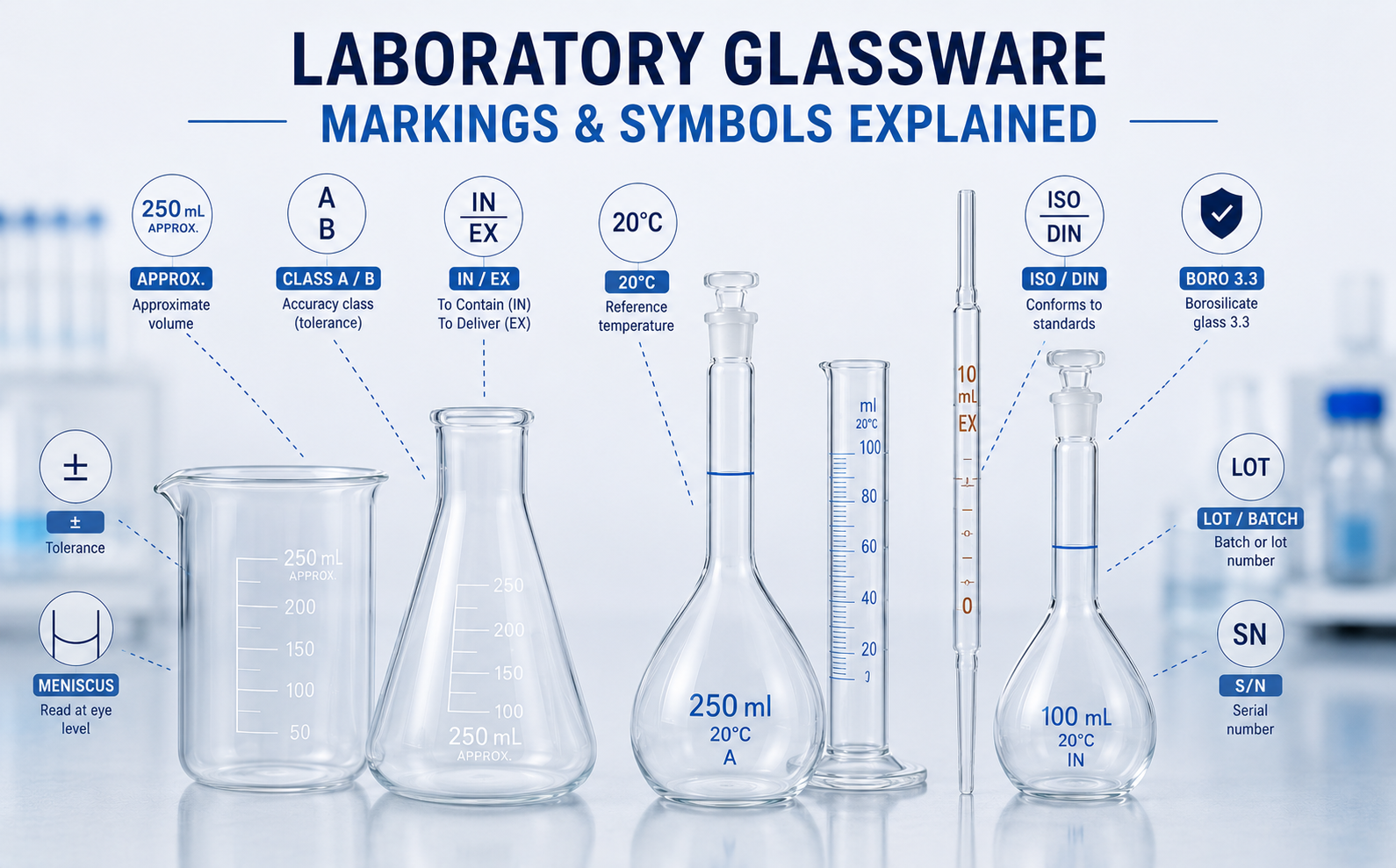
Beakers and Erlenmeyer flasks are among the most widely used types of laboratory glassware. Although both can be used for preparing, mixing, heating and transferring liquids, they are not designed for exactly the same purpose.

Beaker or Erlenmeyer Flask? Choosing the Right One for Your Application
Beakers and Erlenmeyer flasks are among the most widely used types of laboratory glassware. Although both can be used for preparing, mixing, heating and transferring liquids, they are not designed for exactly the same purpose.
Choosing the right vessel can improve handling, safety, mixing performance and overall laboratory efficiency.
When Should You Use a Beaker?
Beakers are highly practical for everyday laboratory work thanks to their wide opening, cylindrical shape and pouring spout.
They are particularly suitable for:
- Preparing solutions
- Mixing solids and liquids
- General heating
- Transferring liquids
- Monitoring approximate volume
- Sample preparation
The wide opening makes it easier to work with spatulas, glass rods and other laboratory tools.
The pouring spout also makes controlled transfer to another vessel more convenient.
However, beaker graduations generally indicate approximate volumes. For precise measurements, calibrated volumetric glassware such as volumetric flasks, pipettes or burettes should be used.
When Should You Use an Erlenmeyer Flask?
The conical body and narrow neck of an Erlenmeyer flask make it particularly useful for mixing and swirling.
It is commonly used for:
- Mixing solutions
- Swirling operations
- Titration
- Reaction preparation
- Temporary liquid storage
- Controlled heating
The narrow neck helps reduce splashing during swirling.
For this reason, Erlenmeyer flasks are especially practical during titrations, where liquid from a burette must be mixed continuously.
Which Is Better for Mixing?
The answer depends on the mixing method.
If mixing manually with a glass rod or spatula, the wide opening of a beaker is more convenient.
If the liquid is mixed by swirling, the conical geometry and narrow neck of the Erlenmeyer flask help keep the liquid under control.
Both can also be used with magnetic stirrers, depending on volume, splash risk and stir-bar size.
Beaker or Erlenmeyer for Heating?
Both can be suitable for certain heating applications when manufactured from appropriate glass.
The borosilicate 3.3 glass used in BOROX laboratory glassware provides low thermal expansion and high chemical resistance for a wide variety of applications.
A beaker's wider surface can be advantageous for heating and evaporation.
An Erlenmeyer flask's narrow neck can help reduce splashing and exposed surface area.
The suitability of any glassware for heating should always be evaluated according to the manufacturer's specifications and intended conditions of use.
Why Is an Erlenmeyer Flask Commonly Used for Titration?
During titration, the analyte solution must be mixed continuously.
The wide base and narrow neck of an Erlenmeyer flask allow the vessel to be swirled while helping reduce the risk of splashing or spilling.
This makes it one of the most commonly used vessels for manual titration with a burette.
Which Is Better for Liquid Transfer?
When liquid needs to be poured into another vessel, a beaker with a pouring spout is generally more convenient.
An Erlenmeyer flask, on the other hand, helps keep the liquid more contained during swirling and handling.
The correct choice depends on the procedure.
Capacity Matters Too
Do not select a beaker or Erlenmeyer flask based only on the amount of liquid being used.
Adequate free volume should remain for mixing, swirling, heating or reactions.
For example, if 250 ml of liquid will be mixed vigorously, a vessel larger than 250 ml may be a more appropriate choice.
Can Beakers and Erlenmeyer Flasks Replace Each Other?
For some routine applications, either may work. However, vessel geometry can directly affect the safety and efficiency of the procedure.
As a general guide:
Beaker: open handling, mixing, pouring and general-purpose work.
Erlenmeyer flask: swirling, titration, controlled mixing and reduced splashing.
The best approach is to choose glassware according to the procedure, not only the volume.
BOROX Glassware for the Right Application
BOROX beakers and Erlenmeyer flasks provide solutions for a wide range of applications, from routine laboratory work to research and education.
Right form + right capacity + right glass = a more efficient laboratory workflow.
BOROX® — Precision in Every Detail.