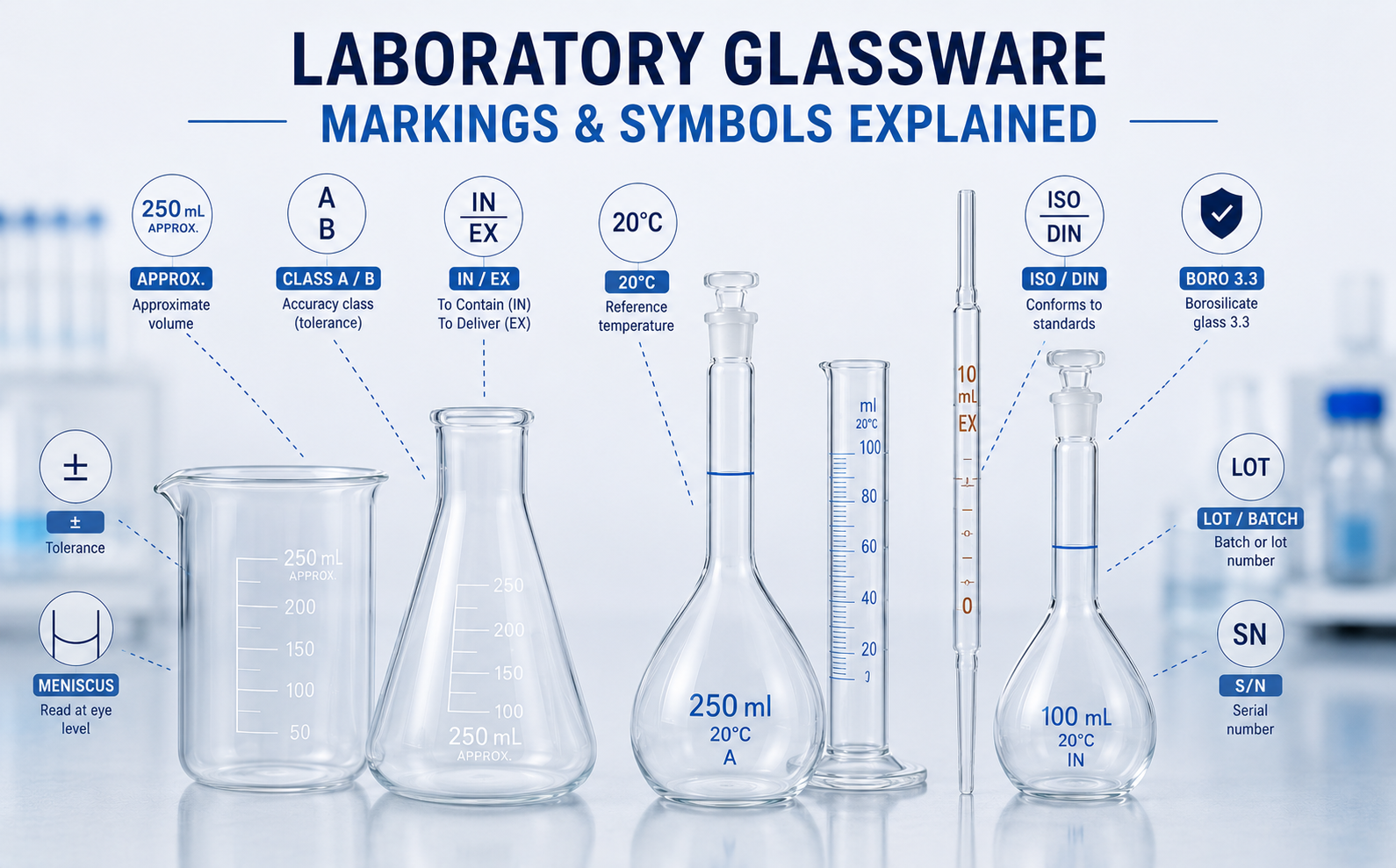
Laboratory glassware is essential to everyday laboratory operations. From beakers and Erlenmeyer flasks to pipettes and burettes, different types of glassware are continuously used for sample preparation, mixing, measurement, titration, heating and solution preparation. Planning an effective glassware inventory therefore requires more than simply deciding which products to purchase. Product type, capacity, frequency of use, measurement accuracy, breakage risk and safety stock requirements should all be considered. A well-planned inventory supports uninterrupted laboratory operations while helping reduce unnecessary stock and purchasing costs.

1. Start with Laboratory Applications
Every laboratory has different requirements.
Educational laboratories may use larger quantities of general-purpose products such as beakers, Erlenmeyer flasks, test tubes and graduated cylinders. Analytical laboratories may require more volumetric pipettes, volumetric flasks and burettes.
The first question should therefore be:
Which procedures will be performed, and how frequently?
Once this is established, the required glassware categories become easier to define.
2. Prioritize Essential Glassware
Common laboratory inventory may include:
- Beakers
- Erlenmeyer flasks
- Graduated cylinders
- Volumetric flasks
- Pipettes
- Burettes
- Test tubes
- Reagent and laboratory bottles
- Separatory funnels
- Watch glasses
Not every category requires the same stock quantity. Inventory levels should reflect actual frequency of use.
3. Plan the Right Capacity Range
Product variety alone is not enough. Capacity distribution is equally important.
Keeping only 1000 mL beakers, for example, would be inefficient for routine 50–100 mL procedures.
For commonly used beakers and Erlenmeyer flasks, a balanced selection of small, medium and large capacities is usually more practical.
Volumes such as 50 mL, 100 mL, 250 mL, 500 mL and 1000 mL can form a useful starting range, depending on laboratory applications.
4. Plan Volumetric Glassware Separately
Volumetric flasks, volumetric pipettes and burettes should be considered separately from general-purpose glassware because they are designed for accurate volume measurement or delivery.
Selection criteria should include capacity, tolerance class, calibration type and applicable standards.
For accurate analytical work, appropriate Class A or Class AS glassware should be considered where required.
5. Consider Borosilicate 3.3 Glass
Glass type becomes particularly important in applications involving heating, temperature changes or contact with chemicals.
Borosilicate 3.3 glass is widely used in laboratories because of its low thermal expansion and high chemical resistance.
The technical properties of frequently used beakers, flasks and bottles should therefore match their intended operating conditions.
6. Account for Breakage and Safety Stock
Even high-quality laboratory glassware can break.
Frequently handled products such as beakers, flasks, pipettes and test tubes may become damaged over time.
Keeping a reasonable safety stock for frequently used and operationally critical products helps prevent unexpected interruptions.
7. Classify Inventory by Usage
A simple ABC approach can be useful:
A – High-use products: frequently used beakers, flasks, test tubes and pipettes.
B – Regular-use products: volumetric flasks, cylinders and selected bottle sizes.
C – Specialized products: separatory funnels, specialized glass components and rarely used capacities.
This approach helps avoid overstocking less frequently used items.
8. Establish Minimum Stock Levels
Frequently used products should have predefined minimum inventory levels.
Reordering can begin when stock falls below this level.
Minimum stock should consider average consumption, breakage rate, supplier lead time, purchasing frequency, workload and product criticality.
9. Define Standards and Quality Requirements
Inventory descriptions should go beyond product name and capacity when necessary.
Instead of simply specifying:
“50 mL burette”
a laboratory may need:
“50 mL – Class AS – burette according to the applicable ISO standard.”
Clear specifications reduce the risk of purchasing technically unsuitable products.
10. Avoid Both Understocking and Overstocking
Too little inventory can interrupt laboratory operations, while excessive inventory can unnecessarily consume storage space and purchasing budgets.
The goal is therefore not to store as much glassware as possible, but to maintain the right product, in the right quantity, at the right time.
Conclusion
Effective laboratory glassware inventory planning should reflect real applications, usage frequency and technical requirements.
By considering product type + capacity + usage frequency + accuracy + safety stock + lead time, laboratories can build a more efficient inventory system.
The right inventory supports a more efficient laboratory.