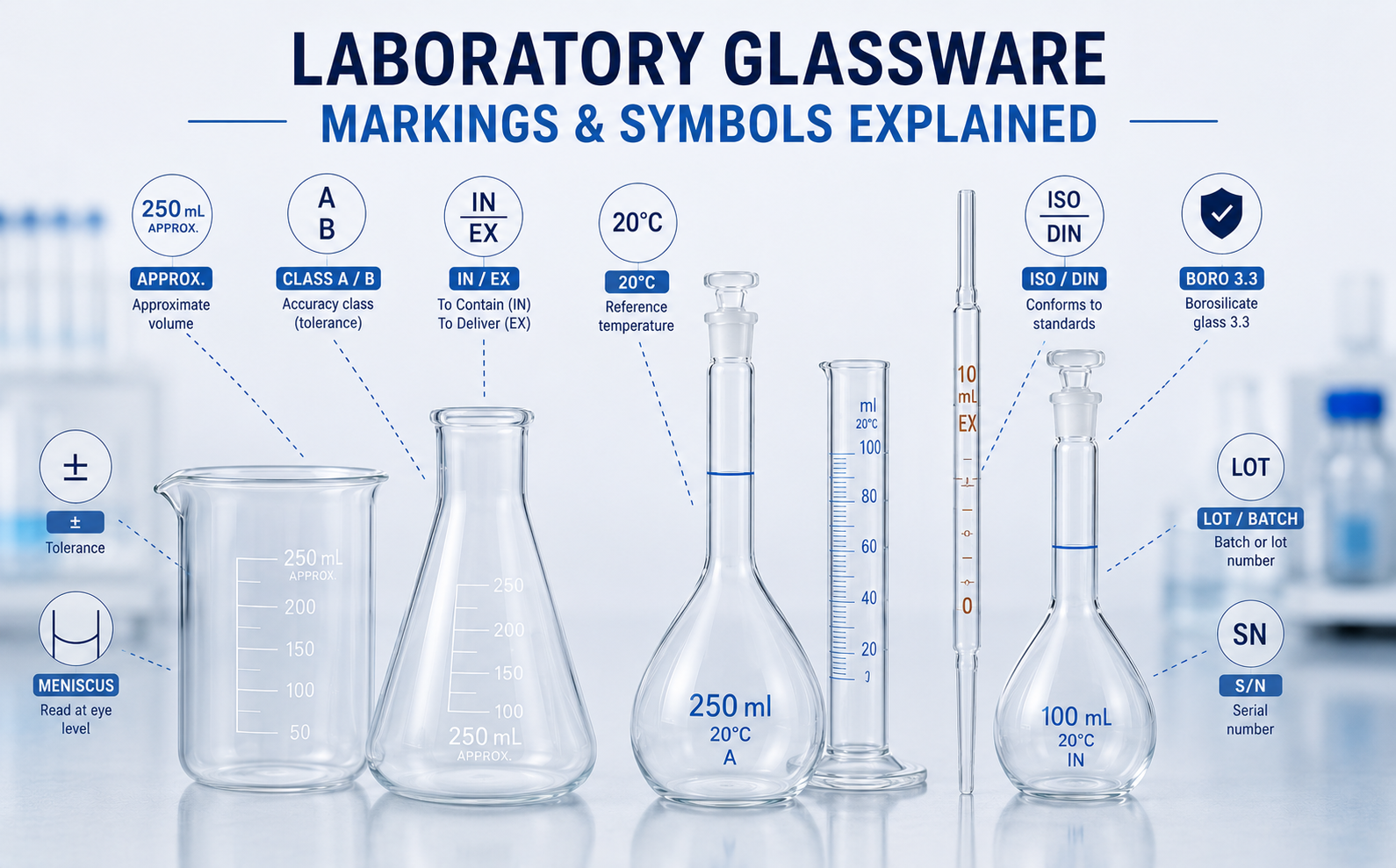
Borosilicate 3.3 glass is one of the most widely used materials for laboratory glassware because of its high chemical resistance, low thermal expansion and excellent performance under temperature changes. From beakers and Erlenmeyer flasks to burettes, pipettes and laboratory bottles, a wide range of laboratory products can be manufactured from this glass. But what makes borosilicate 3.3 different from ordinary glass? The answer lies largely in its chemical composition and glass network structure.

What Is Borosilicate 3.3 Glass?
Borosilicate 3.3 is a special glass based primarily on silicon dioxide (SiO₂) and boron oxide (B₂O₃).
The designation "3.3" does not represent the percentage of boron in the glass. It refers to its approximate linear coefficient of thermal expansion:
α ≈ 3.3 × 10⁻⁶ K⁻¹
This low thermal expansion helps reduce dimensional changes and internal stresses when the glass is exposed to temperature variations.
Typical Chemical Composition
Exact compositions can vary slightly by manufacturer, but a typical borosilicate 3.3 composition is approximately:
| Component | Approximate Content |
|---|---|
| SiO₂ – Silicon dioxide | ~80–81% |
| B₂O₃ – Boron oxide | ~12–13% |
| Na₂O + K₂O – Alkali oxides | ~4% |
| Al₂O₃ – Aluminium oxide | ~2–3% |
The controlled combination of these components gives borosilicate 3.3 its characteristic chemical and thermal properties.
Role of Silicon Dioxide
SiO₂ forms the principal network of the glass.
Its high concentration contributes to:
- chemical stability,
- structural integrity,
- high-temperature performance,
- resistance to many chemicals.
Role of Boron Oxide
B₂O₃ is one of the key components that distinguishes borosilicate glass from conventional soda-lime glass.
Its incorporation into the glass network contributes to:
- lower thermal expansion,
- improved resistance to temperature changes,
- better thermal shock performance,
- high chemical stability.
This combination is particularly valuable in laboratory environments where both chemical and thermal stresses are common.
Role of Alkali and Aluminium Oxides
Alkali oxides such as Na₂O and K₂O play important roles in glass production, while their controlled concentration helps maintain the desired chemical performance.
Al₂O₃ contributes to the stability and durability of the glass network.
The performance of borosilicate 3.3 therefore results from the carefully controlled interaction of several components rather than a single oxide.
High Hydrolytic Resistance
One of the major advantages of borosilicate 3.3 is its high hydrolytic resistance.
Limited release of components from the glass surface during contact with water is particularly valuable for:
- analytical chemistry,
- solution preparation,
- sample storage,
- sensitive laboratory procedures.
High hydrolytic resistance is therefore an important indicator of chemical stability.
Resistance to Acids
Borosilicate 3.3 provides high resistance to many acids commonly encountered in laboratories.
An important exception is hydrofluoric acid (HF).
HF attacks the silica structure of glass, making standard borosilicate glassware unsuitable for its handling or storage.
Behaviour with Alkalis
Strong alkaline solutions can attack glass surfaces, particularly when high concentration, elevated temperature and prolonged contact occur together.
Chemical compatibility should therefore always be evaluated according to actual operating conditions.
Why Is Low Thermal Expansion Important?
The low coefficient of thermal expansion of approximately 3.3 × 10⁻⁶ K⁻¹ is one of the defining properties of borosilicate 3.3.
It helps:
- reduce dimensional changes during heating and cooling,
- limit thermal stresses,
- improve performance under temperature changes,
- provide better thermal shock resistance than conventional soda-lime glass.
However, borosilicate glass is not unbreakable. Extreme or uneven temperature changes can still cause failure.
Why Is It Suitable for Heated Laboratory Applications?
Beakers, Erlenmeyer flasks and certain laboratory flasks are frequently subjected to heating.
Borosilicate 3.3 provides an important advantage in such applications because of its low thermal expansion.
Nevertheless, users should avoid:
- placing hot glass directly on cold surfaces,
- suddenly adding cold liquid to hot glass,
- severe localized heating,
- heating scratched or cracked glassware.
Borosilicate 3.3 vs Soda-Lime Glass
| Property | Borosilicate 3.3 | Soda-Lime Glass |
|---|---|---|
| B₂O₃ content | High | Very low / absent |
| Thermal expansion | Low | Higher |
| Thermal shock resistance | High | Lower |
| Hydrolytic resistance | Generally high | Composition-dependent |
| Heating applications | Highly suitable | More limited |
| Chemical resistance | High | Generally lower |
Is Borosilicate 3.3 Suitable for Every Application?
No material is universally suitable.
Special consideration is required for:
- hydrofluoric acid,
- strong alkalis at elevated temperatures,
- prolonged chemical storage,
- light-sensitive substances,
- applications involving severe mechanical impact.
Material selection should therefore consider chemical + concentration + temperature + contact time + application.
Conclusion
The widespread use of borosilicate 3.3 in laboratories is not simply because it is "heat-resistant glass."
Its characteristic composition—typically around 80–81% SiO₂ and 12–13% B₂O₃—provides a combination of low thermal expansion, high hydrolytic resistance and excellent chemical performance.
These properties make borosilicate 3.3 a reliable material for a wide range of laboratory glassware.