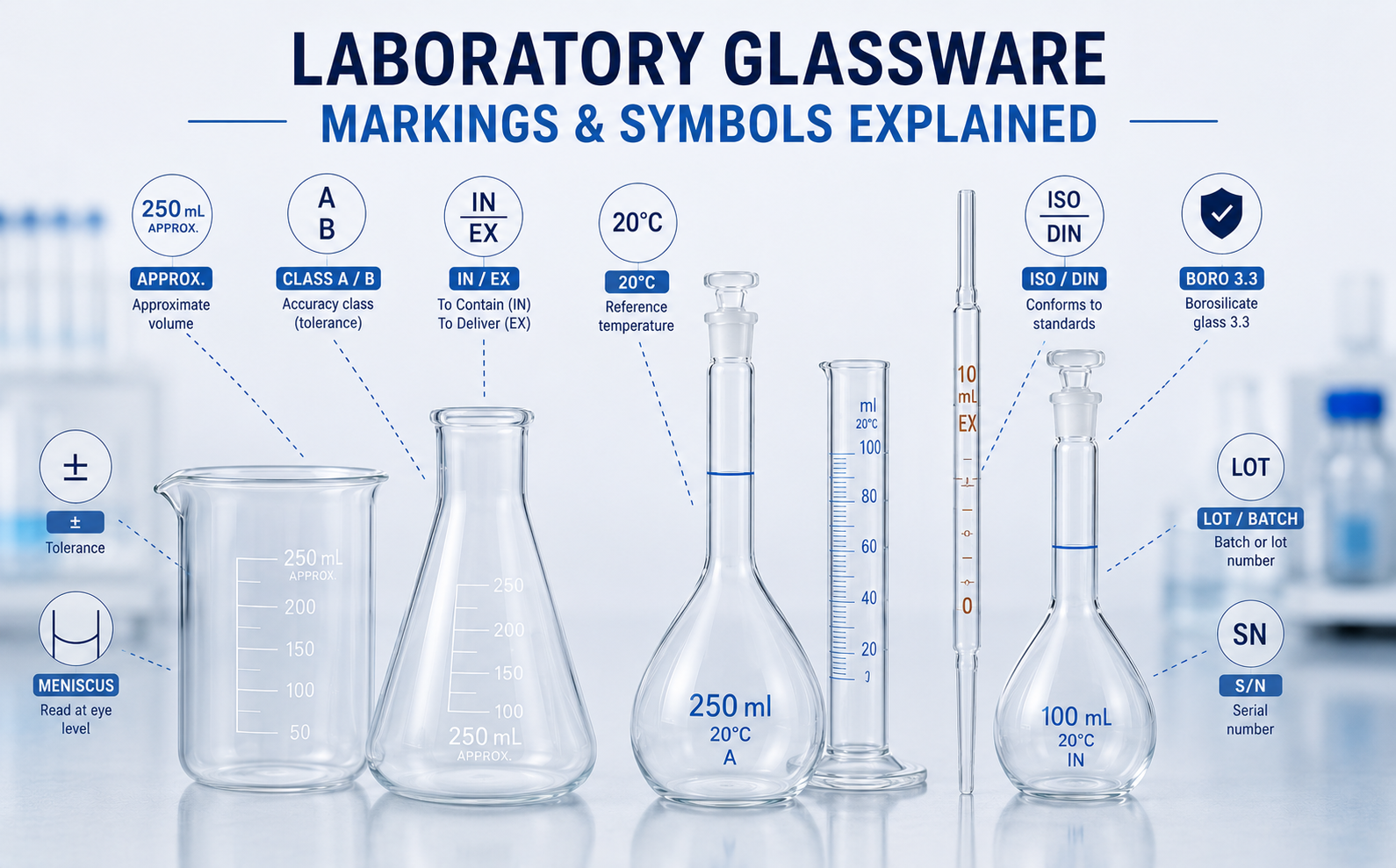
Reliable laboratory results depend not only on the correct instruments, methods and reagents, but also on selecting the right materials for every surface that comes into contact with the sample. Glass, plastics, metals, seals and fittings may interact with samples in different ways. An unsuitable material can release unwanted substances, adsorb analytes or carry residues from previous samples. Material selection should therefore be considered an important part of laboratory contamination control.

What Is Laboratory Contamination?
Contamination occurs when an unwanted substance is introduced into a sample or solution. It may originate from the environment, laboratory equipment, containers or consumables.
Contamination can alter analytical results, increase blank values, affect sample purity, reduce reproducibility and cause interference in sensitive analytical methods.
This is particularly important in HPLC, ICP, AAS, GC, spectrophotometry and trace analysis, where even very small amounts of contamination may be significant.
1. Glass or Plastic?
There is no single material that is ideal for every laboratory application.
Borosilicate glass offers high chemical resistance and low thermal expansion, making it suitable for many laboratory applications. However, potential ion release or adsorption effects may need to be considered in specific analytical procedures.
Plastics such as PP, PE and HDPE offer different chemical-resistance profiles and can provide advantages for certain sample preparation, transportation and storage applications.
The correct choice therefore depends on compatibility with the application, rather than simply choosing one material as universally superior.
2. Leaching from the Material
Even apparently inert containers can potentially release small amounts of substances into a sample.
Depending on formulation and manufacturing processes, plastics may contain additives or low-molecular-weight components. Glass and metallic surfaces may also require consideration in specific elemental or trace analyses.
This phenomenon is commonly known as leaching.
When measuring very low concentrations, even a small contribution from the container can become analytically significant.
3. What About Adsorption?
Contamination control is not only about preventing foreign substances from entering a sample. Analytes can also be lost by binding to container surfaces.
Proteins, biomolecules, certain organic compounds and trace-level analytes may adsorb onto particular surfaces.
Therefore, sensitive applications should consider both:
“Can this material release something into my sample?”
and
“Can my analyte bind to this material?”
4. Why Is Chemical Compatibility Important?
If a sample or reagent is chemically incompatible with the laboratory product, the material may gradually deteriorate.
Cracking, swelling, surface degradation, particle formation and leakage can eventually contribute to contamination.
The entire fluid-contact path should therefore be evaluated, including containers, caps, seals, stopcocks, tubing and fittings.
5. The Role of Single-Use Products
Single-use laboratory consumables such as pipette tips, centrifuge tubes, sample containers, Petri dishes and certain filtration products can help reduce cross-contamination when used correctly.
However, “single-use” alone does not guarantee suitability.
Material composition, manufacturing cleanliness, packaging integrity, sterility requirements and compatibility with the intended application should all be considered.
6. Residues After Cleaning
Reusable glassware and equipment can become sources of contamination if they are not cleaned correctly.
Detergent residues, insufficient rinsing, residues from previous samples or unsuitable cleaning chemicals may interfere with subsequent analyses.
A suitable cleaning procedure is therefore just as important as choosing the correct material.
7. What Should Be Considered for Critical Analyses?
| Evaluation | Key question |
|---|---|
| Chemical compatibility | Can the sample react with the material? |
| Leaching | Can components migrate from the material into the sample? |
| Adsorption | Can the analyte bind to the surface? |
| Temperature | Is the material stable at the operating temperature? |
| Cleanability | Can residues be reliably removed? |
| Reuse | Is there a risk of cross-contamination? |
| Purity requirements | Is the analysis sensitive to trace contamination? |
Conclusion
Contamination control begins long before a sample reaches the analytical instrument.
From the beaker used during preparation and the bottle used for storage to the pipette tip and filtration system, every surface that contacts the sample matters.
Selecting materials according to chemical compatibility, purity, leaching potential, adsorption behavior, cleanability and intended use helps reduce contamination, improve reproducibility and produce more reliable laboratory results.