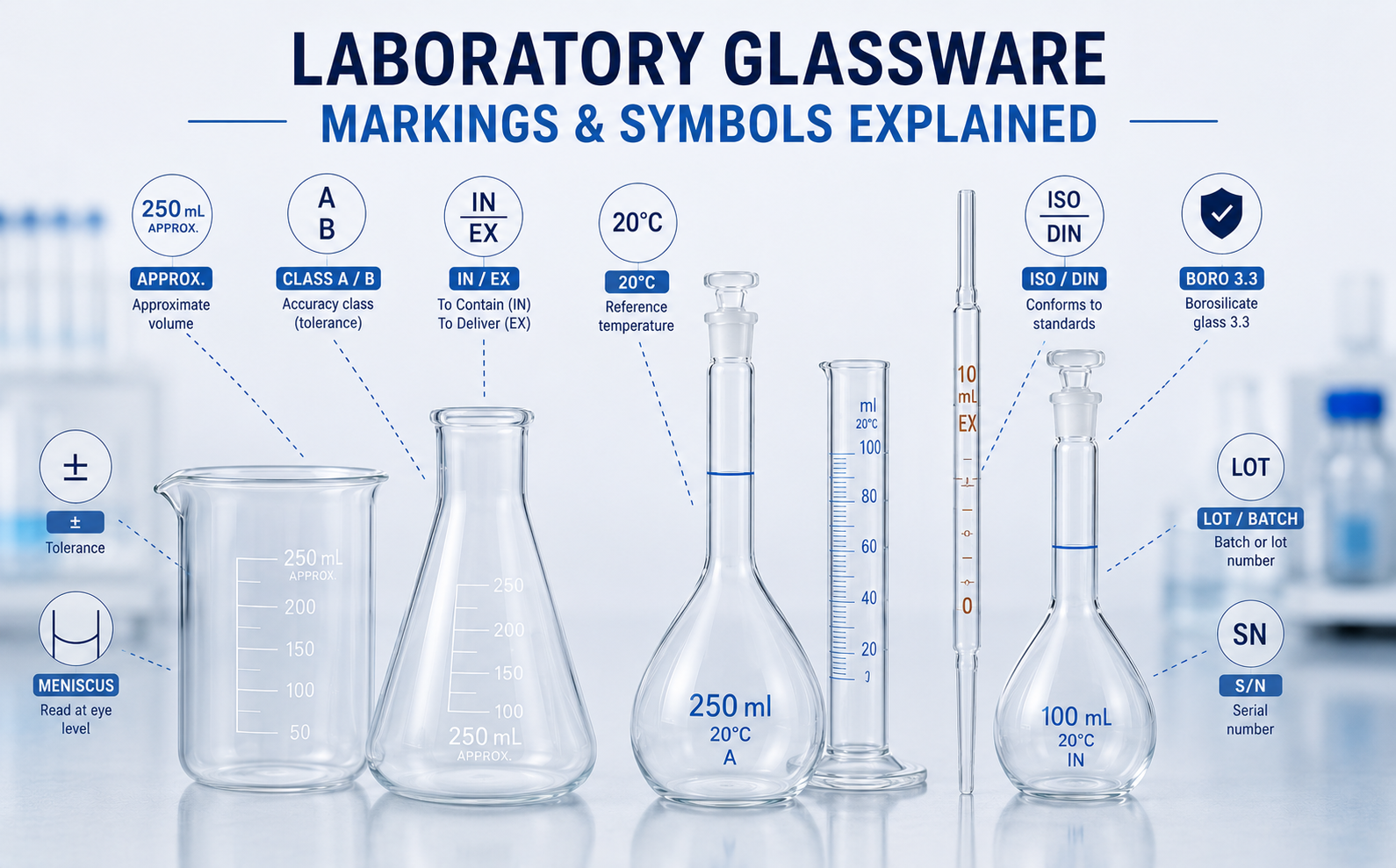
The Erlenmeyer flask, also known as a conical flask, is one of the most versatile pieces of laboratory glassware. Its flat base, conical body and narrow neck make it suitable for mixing, titration, solution preparation, heating and many other procedures. Different designs are available for different applications.

1. Narrow-Neck Erlenmeyer Flask
The standard narrow-neck flask is commonly used for:
- titration,
- solution preparation,
- manual mixing,
- chemical reactions,
- sample preparation.
Its narrow neck helps reduce splashing during swirling.
2. Wide-Neck Erlenmeyer Flask
A wide-neck flask provides easier access to the interior.
It is particularly useful for:
- adding solid materials,
- transferring powders,
- easier filling,
- easier cleaning.
3. Ground-Joint Erlenmeyer Flask
These flasks incorporate a standard ground-glass joint, such as NS 19/26 or NS 24/29.
Compatible glass stoppers, adapters and other components can therefore be connected to the flask.
4. Screw-Cap Erlenmeyer Flask
A screw-cap model provides convenient closure for handling samples and solutions.
Cap and liner materials must always be checked for chemical compatibility with the contents.
5. Filtering Flask / Kitasato Flask
A Kitasato or filtering flask is a specially designed heavy-duty flask with a side arm for connection to a vacuum line.
Its primary application is vacuum filtration, commonly with a Büchner funnel.
A standard Erlenmeyer flask should not be substituted for a flask specifically designed and approved for vacuum use.
6. Baffled Erlenmeyer Flask
Baffled flasks contain internal features that increase turbulence during orbital shaking.
They can improve mixing and gas-liquid contact and are commonly used in:
- microbiology,
- biotechnology,
- microbial cultures,
- fermentation research,
- shaker applications.
7. Graduated Erlenmeyer Flask
Many Erlenmeyer flasks include graduation marks for approximate volume estimation.
These markings should generally not be considered a substitute for calibrated volumetric glassware when accurate volume measurement is required.
Comparison
| Type | Main Feature | Typical Application |
|---|---|---|
| Narrow-neck | Narrow opening | Titration and mixing |
| Wide-neck | Large opening | Adding solids |
| Ground-joint | Glass joint | Connected systems |
| Screw-cap | Threaded closure | Sample/solution handling |
| Kitasato | Vacuum side arm | Vacuum filtration |
| Baffled | Internal baffles | Shaker cultures |
| Graduated | Approximate scale | General volume monitoring |
Why Is an Erlenmeyer Flask Used for Titration?
The conical body allows the solution to be swirled efficiently while titrant is added from a burette.
The narrow neck helps reduce splashing, making the Erlenmeyer flask an excellent receiving vessel for manual titration.
Borosilicate 3.3
Borosilicate 3.3 is widely used for laboratory flasks because it provides:
- low thermal expansion,
- good thermal shock resistance,
- high hydrolytic resistance,
- good resistance to many chemicals,
- excellent transparency.
Erlenmeyer Flask vs. Beaker
A beaker offers a wide opening and easy access, while an Erlenmeyer flask provides better control during swirling.
Neither should normally be used as a substitute for calibrated volumetric glassware when high measurement accuracy is required.
Choosing the Correct Flask
Consider:
application + capacity + neck design + glass type + closure/joint + temperature + pressure conditions.
For vacuum work, always use a flask specifically designed and approved for the intended vacuum conditions.