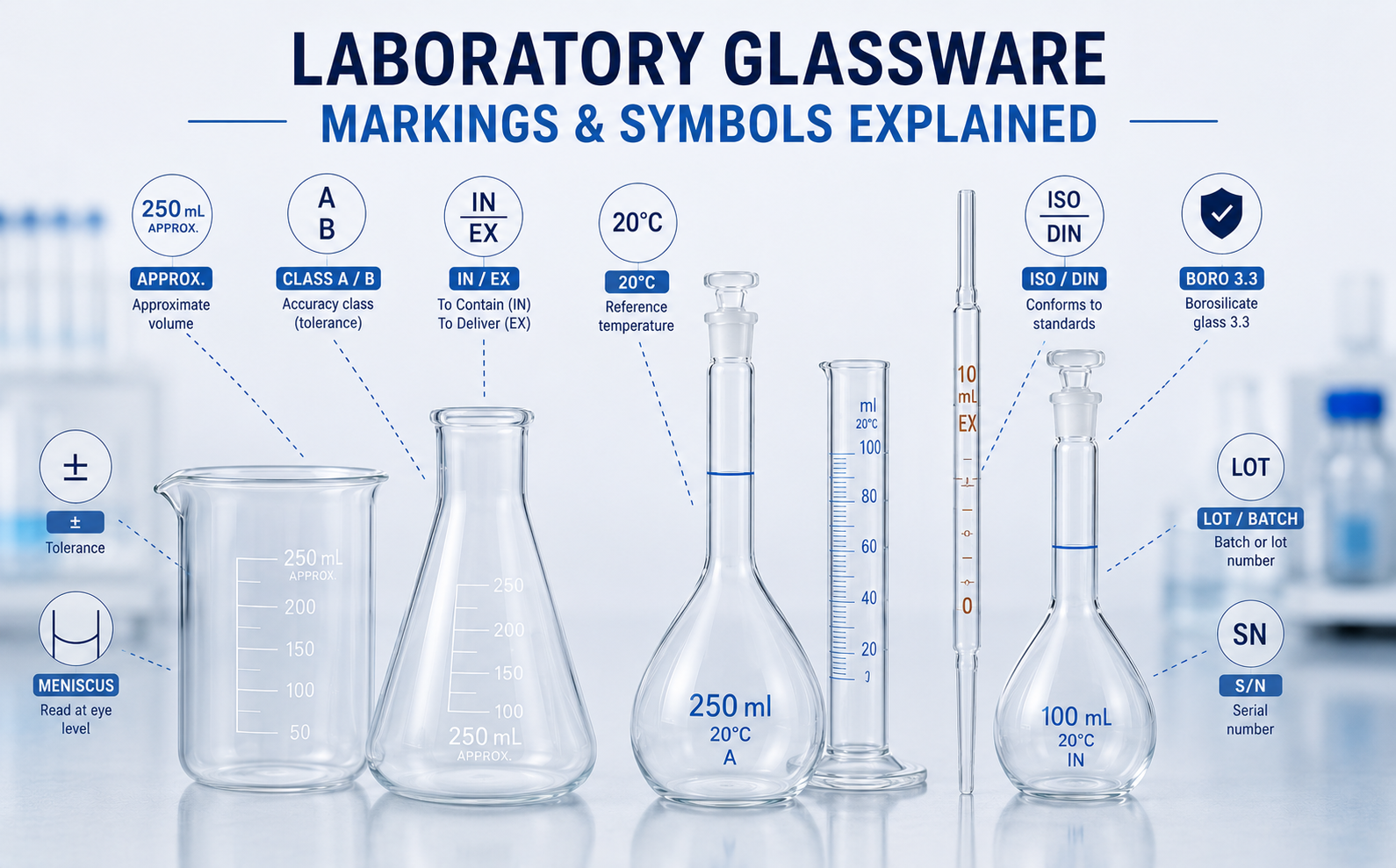
When evaluating laboratory glassware, mechanical strength and thermal resistance are not the only important properties. The ability of glass to maintain its chemical stability when exposed to water is equally important. This property is known as hydrolytic resistance. For laboratory products such as beakers, Erlenmeyer flasks, volumetric flasks, pipettes, burettes, graduated cylinders and bottles, hydrolytic resistance is an important indicator of glass quality and chemical stability. Two internationally recognized standards commonly associated with this property are ISO 719 and ISO 720.

What Is Hydrolytic Resistance?
Glass is highly chemically resistant, but it is not completely inert. When glass comes into contact with water, very small quantities of soluble components may be released from its surface.
Hydrolytic resistance describes the ability of glass to resist this chemical attack by water.
In general, the lower the amount of extractable components released into the water, the higher the hydrolytic resistance of the glass.
This is particularly important in analytical applications where ions released from glass could potentially affect pH, conductivity or sample composition.
Why Is Hydrolytic Resistance Important?
High hydrolytic resistance:
- Indicates good chemical stability of the glass
- Helps minimize the release of components into solutions
- Reduces potential contamination in sensitive applications
- Supports reproducible analytical results
- Contributes to reliable long-term performance
For this reason, hydrolytic resistance is an important technical parameter when evaluating laboratory glass.
What Is ISO 719?
ISO 719 is an international standard used to determine the hydrolytic resistance of glass grains at 98 °C.
The method involves preparing glass particles of specified dimensions and exposing them to water under defined conditions.
The resulting extract is then evaluated to determine the hydrolytic resistance class of the glass.
In simplified form:
Glass → Prepared as specified grains → Exposed to water at 98 °C → Extract evaluated → Hydrolytic class determined
The lower the quantity of extractable components, the higher the hydrolytic resistance.
ISO 719 Classification
Under ISO 719, glasses are classified according to their hydrolytic resistance.
Glasses demonstrating the highest level of resistance can be classified as HGB 1.
High-quality laboratory glasses such as borosilicate 3.3 can provide excellent hydrolytic resistance when produced to the appropriate composition and quality.
Importantly, ISO 719 primarily characterizes the glass material in grain form, rather than directly testing the complete finished laboratory vessel.
What Is ISO 720?
ISO 720 also evaluates the hydrolytic resistance of glass grains, but under different test conditions.
The test is conducted at 121 °C, exposing the glass to water at a higher temperature than ISO 719.
The method similarly uses prepared glass grains and evaluates the resulting aqueous extract.
ISO 720 Classification
Under ISO 720, glasses with high hydrolytic resistance may be classified as HGA 1.
Technical specifications may therefore include statements such as:
Hydrolytic resistance ISO 719: HGB 1
Hydrolytic resistance ISO 720: HGA 1
These classifications indicate high hydrolytic resistance under the respective standardized test conditions.
ISO 719 vs ISO 720
| Property | ISO 719 | ISO 720 |
|---|---|---|
| Property evaluated | Hydrolytic resistance | Hydrolytic resistance |
| Sample | Glass grains | Glass grains |
| Test temperature | 98 °C | 121 °C |
| High resistance class | HGB 1 | HGA 1 |
| Main distinction | Water resistance at 98 °C | Water resistance at higher temperature |
Both standards provide useful information about the chemical stability of glass against water, but their test conditions and classification systems differ.
Borosilicate 3.3 and Hydrolytic Resistance
Borosilicate 3.3 glass is widely used for laboratory glassware because it combines:
- High hydrolytic resistance
- High chemical resistance
- Low thermal expansion
- Good thermal shock resistance
- Compatibility with many laboratory chemicals
Its hydrolytic stability is particularly valuable in analytical procedures and applications involving aqueous solutions.
Is Hydrolytic Resistance the Same as Chemical Resistance?
Not exactly.
Hydrolytic resistance specifically concerns the resistance of glass to water.
Chemical resistance is a broader concept that may include resistance to:
- water,
- acids,
- alkalis,
- salt solutions,
- other chemical substances.
High hydrolytic resistance therefore does not mean that glass is universally resistant to every chemical.
Why Check ISO 719 and ISO 720?
When selecting laboratory glassware, capacity and appearance alone do not provide enough information about material performance.
For demanding applications, consider:
glass type + hydrolytic resistance + chemical resistance + thermal properties + applicable standards.
Information relating to ISO 719 and ISO 720 can help laboratories objectively evaluate the quality and chemical stability of the glass material.
Conclusion
Hydrolytic resistance describes how effectively glass maintains its chemical stability when exposed to water.
ISO 719 evaluates the hydrolytic resistance of glass grains at 98 °C, while ISO 720 evaluates it at 121 °C.
High-quality borosilicate 3.3 glass provides high hydrolytic resistance, making it suitable for a wide range of laboratory applications.
Understanding these standards helps laboratories make more informed decisions when selecting reliable glassware.