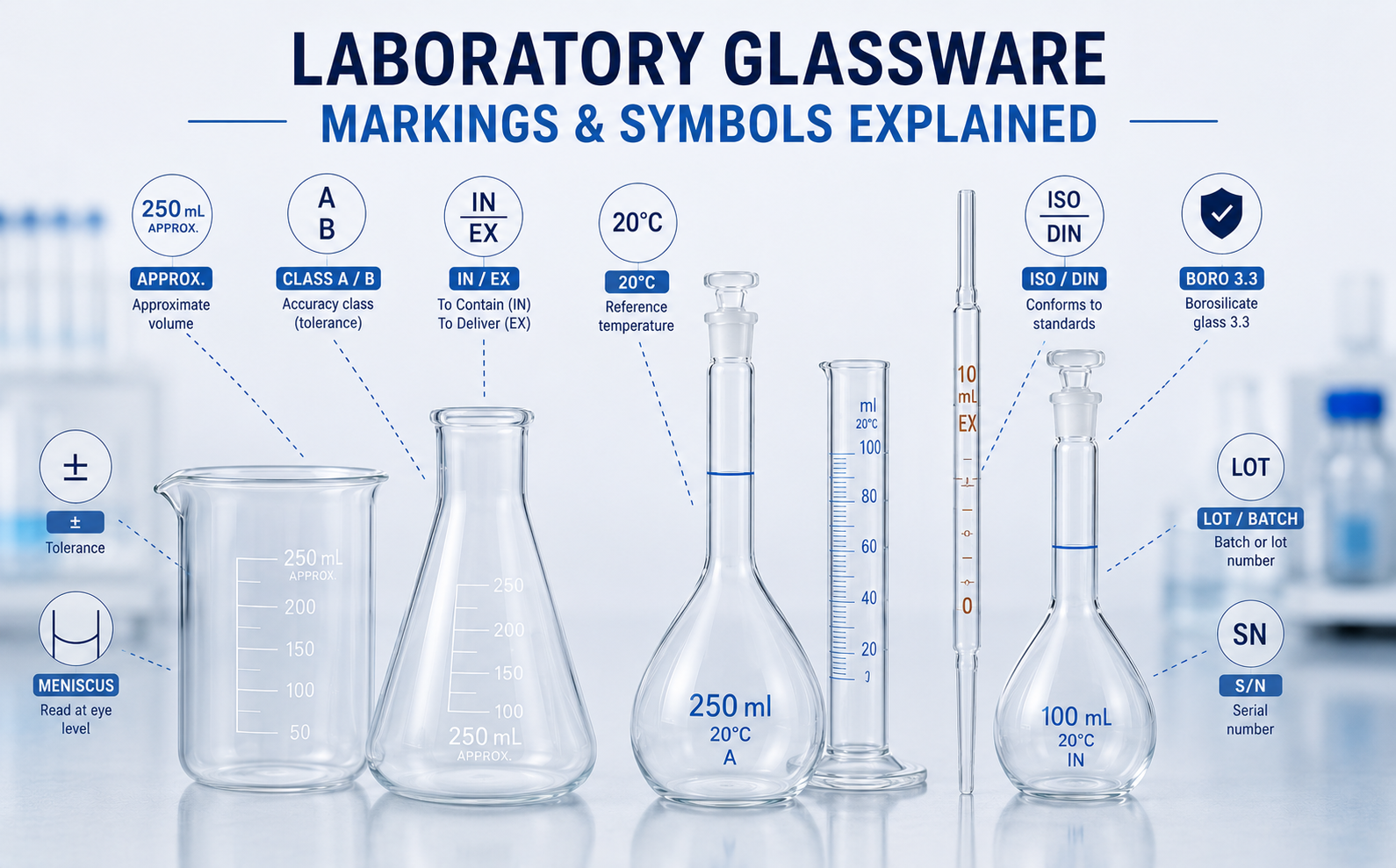
A well-equipped chemistry laboratory depends not only on the right chemicals and instruments, but also on selecting the appropriate laboratory glassware for each application. From beakers and Erlenmeyer flasks to volumetric flasks, pipettes and burettes, every type of glassware serves a specific purpose.

1. Beakers
Beakers are among the most versatile items in a chemistry laboratory. They are commonly used for preparing, mixing, heating and temporarily holding solutions.
Their graduations should generally be considered approximate. For accurate volume measurements, calibrated volumetric glassware should be used.
2. Erlenmeyer Flasks
The conical shape and narrow neck of an Erlenmeyer flask allow solutions to be mixed with a reduced risk of splashing.
They are widely used for solution preparation, mixing, heating, reactions and titrations.
3. Graduated Cylinders
Graduated cylinders provide more accurate volume measurements than standard beakers or Erlenmeyer flasks.
They are ideal for routine volume measurements, while high-precision analytical work generally requires calibrated volumetric glassware.
4. Volumetric Flasks
Volumetric flasks are designed to prepare solutions at a specific and accurately defined volume.
They are particularly important for preparing standard solutions and performing quantitative analytical procedures.
5. Pipettes
Pipettes are used to accurately measure and transfer liquids.
Volumetric pipettes are designed to deliver one specific volume with high accuracy, while graduated pipettes allow different volumes to be measured and transferred.
6. Burettes
Burettes are essential for titration.
Their fine graduations and controlled stopcock systems allow liquids to be delivered precisely. Class A or Class AS burettes are commonly preferred when high accuracy is required.
7. Test Tubes
Test tubes are used for small-scale reactions, sample preparation, heating and observational experiments.
Different sizes and glass types can be selected depending on the application.
8. Glass Funnels
Glass funnels facilitate liquid transfer and filtration.
Combined with filter paper, they are commonly used for separating solid particles from liquid mixtures.
9. Separatory Funnels
Separatory funnels are designed for separating immiscible liquid phases and performing liquid-liquid extraction.
They are particularly useful in organic and analytical chemistry laboratories.
10. Reagent Bottles
Reagent bottles provide safe storage for chemicals, solutions and laboratory reagents.
Clear bottles are suitable for general applications, while amber glass bottles help protect light-sensitive substances.
Why Borosilicate 3.3 Glass?
Many high-quality laboratory glassware products are manufactured from Borosilicate 3.3 glass because of its low thermal expansion, excellent resistance to temperature changes and high resistance to many chemicals.
These properties make it particularly suitable for demanding laboratory applications.
Consider the Accuracy Class
Not every glassware product is intended for precise measurement.
Beakers and Erlenmeyer flasks are primarily used for general preparation and handling, whereas volumetric flasks, pipettes and burettes are designed for applications where measurement accuracy matters.
For precise volumetric work, the applicable accuracy class and relevant ISO or DIN standard should always be considered.
Conclusion
The essential glassware of a chemistry laboratory includes:
Beaker → preparation and mixing
Erlenmeyer flask → mixing, reactions and titration
Graduated cylinder → routine volume measurement
Volumetric flask → accurate solution preparation
Pipette → accurate liquid transfer
Burette → titration
Test tube → small-scale reactions
Funnel → transfer and filtration
Separatory funnel → liquid-liquid extraction
Reagent bottle → chemical storage
Choosing the right glassware supports accuracy, laboratory safety and reproducible experimental results.