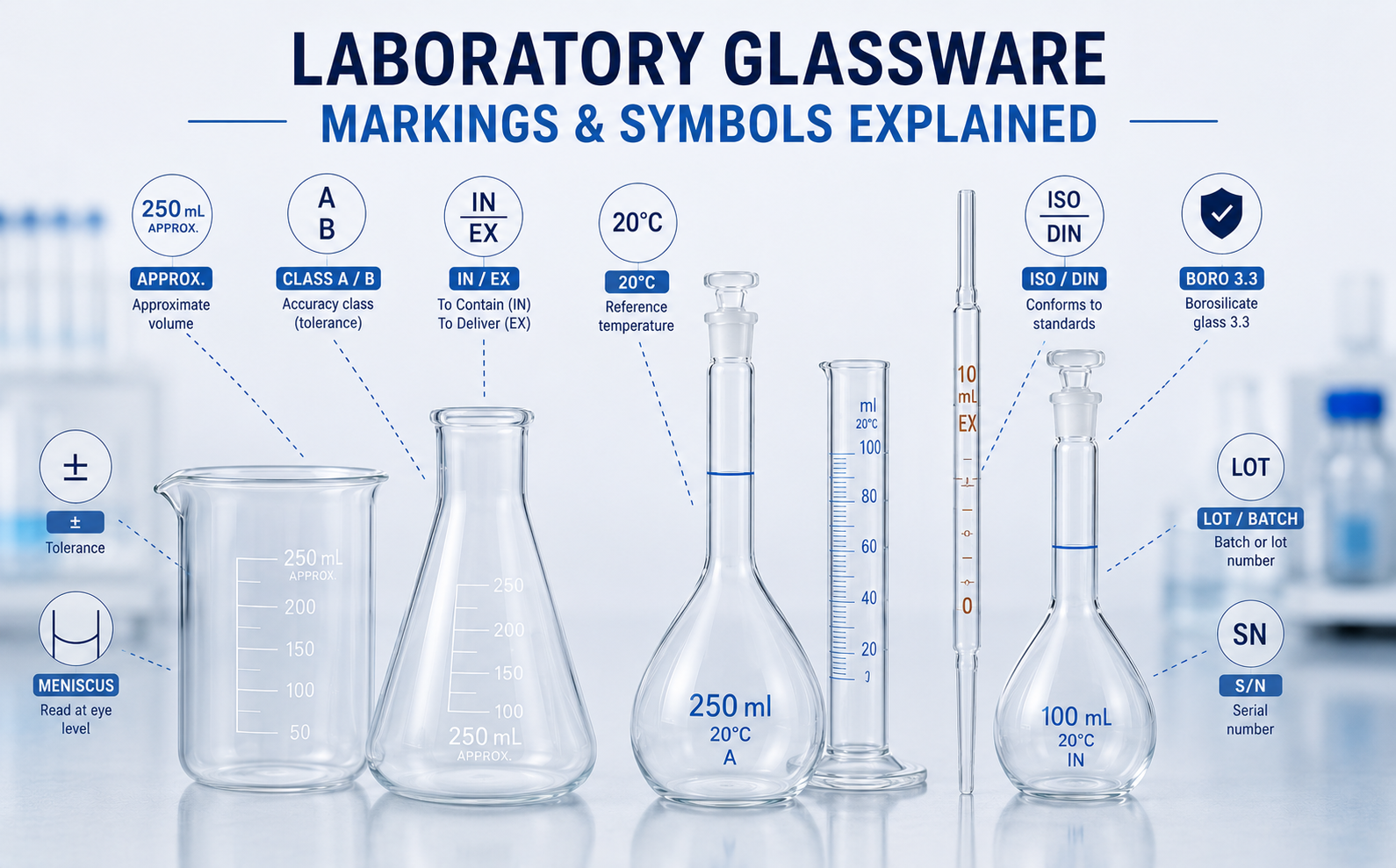
Laboratory glassware is frequently marked with specifications such as NS 14/23, NS 19/26, NS 24/29 or NS 29/32. These markings refer to standardized ground-glass joints that allow flasks, condensers, adapters, funnels and other laboratory components to be connected together. But what exactly does NS mean, and why is selecting the correct joint size important?

What Does NS Mean?
NS comes from the German term Normschliff, referring to a standardized ground-glass joint.
These joints use precisely ground conical glass surfaces that fit together, allowing different pieces of laboratory glassware to form modular experimental systems.
They are commonly found on:
- Round-bottom flasks
- Erlenmeyer and reaction flasks
- Condensers
- Distillation apparatus
- Adapters
- Separatory and dropping funnels
- Thermometer adapters
- Vacuum and reaction systems
What Does NS 14/23, 19/26 or 29/32 Mean?
The two numbers describe different characteristics of the joint.
For example:
NS 29/32
29 → nominal joint width/diameter class
32 → approximate length of the ground joint
It is therefore important to consider the complete NS designation, rather than only the first number.
An NS 29/32 male joint, for example, is designed to fit a corresponding NS 29/32 female joint.
Male and Female NS Joints
Ground-glass joints are generally available in two complementary forms.
A male joint has a ground outer conical surface.
A female joint has a ground inner surface designed to receive the corresponding male joint.
Matching male and female joints allow laboratory assemblies to be built securely and efficiently.
Why Is Standard Taper Important?
Matching the diameter alone is not enough. The taper geometry must also be compatible.
Common standardized ground-glass joints are based on a 1:10 taper, providing consistent fitting between compatible components.
This is particularly important in distillation, reflux, extraction and reaction assemblies.
Common NS Sizes
Frequently encountered laboratory joint sizes include:
NS 10/19 • NS 14/23 • NS 19/26 • NS 24/29 • NS 29/32 • NS 34/35 • NS 45/40
Smaller joints are generally used with smaller laboratory apparatus, while larger joints are suitable for larger-volume glassware and assemblies.
What Should You Consider When Choosing an NS Joint?
Check the complete joint specification when assembling laboratory glassware:
- NS size of male and female joints
- Taper compatibility
- Adapter compatibility
- Intended application
- Vacuum or pressure conditions
- Cleanliness and condition of the ground surfaces
Never force incompatible glass joints together, as this may result in leakage or glass breakage.
Preventing Stuck Ground-Glass Joints
Ground joints may become stuck when left assembled for extended periods or when chemical residues dry between their surfaces.
Joints should therefore be kept clean and suitable joint clips or other appropriate laboratory accessories should be used where required.
Prolonged exposure of ground-glass surfaces to strong alkaline residues should also be avoided.
The Advantage of Standardized Connections
One of the greatest advantages of NS joints is modularity.
Flasks, condensers, adapters and other components with compatible joints can be combined to create different laboratory configurations.
This transforms individual pieces of glassware into a flexible laboratory system.
Conclusion
An NS designation may look like a small technical detail, but it plays an important role in building reliable laboratory assemblies.
Markings such as NS 14/23, NS 19/26 and NS 29/32 identify standardized glass-joint dimensions and help determine which components can be directly connected.
Selecting the correct NS size is therefore an essential step toward building compatible, practical and reliable laboratory systems.
BOROX® – Built For Science.