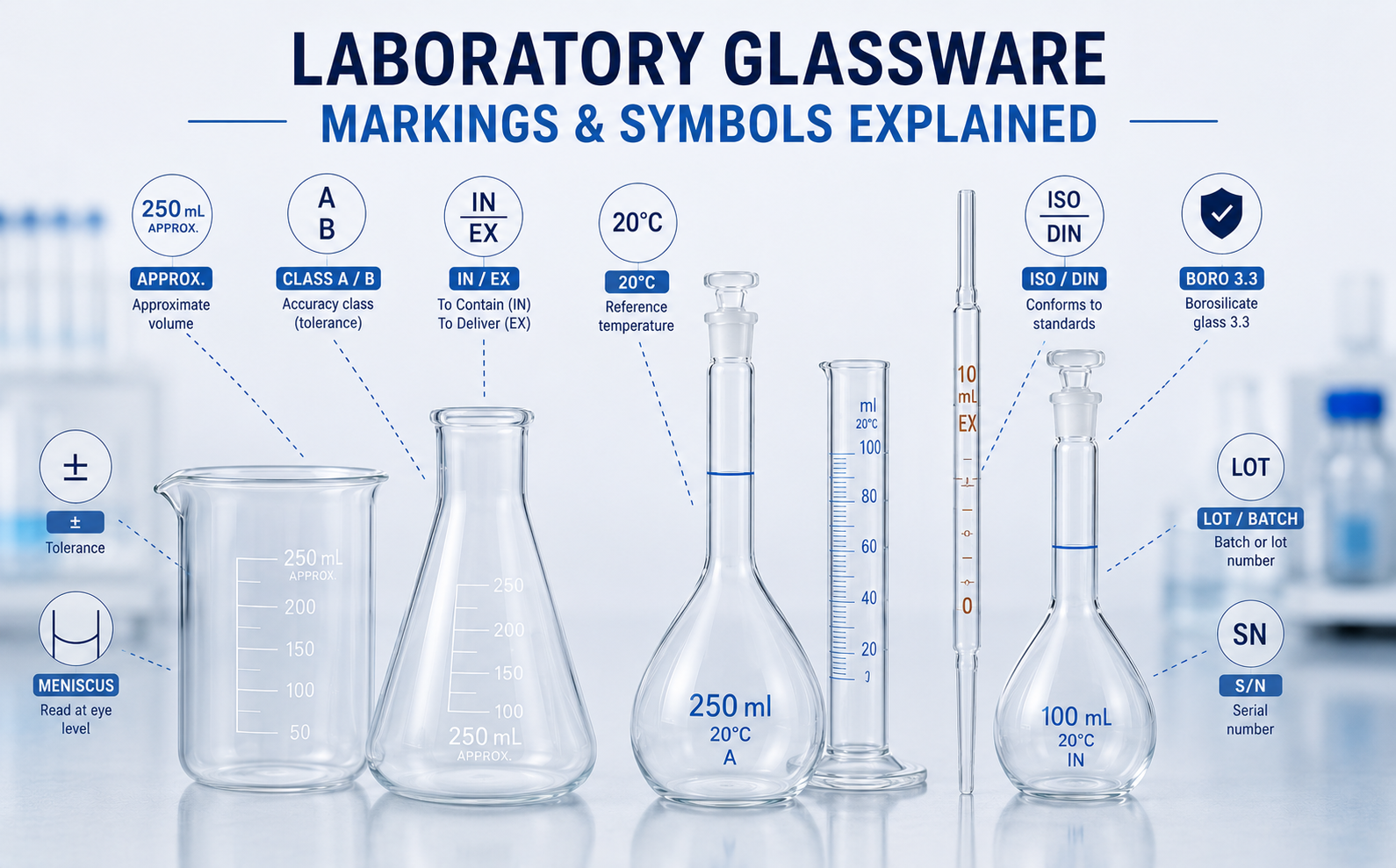
When selecting laboratory glassware, not only the shape or capacity of the product matters. Measurement accuracy, dimensions, design, performance and suitability for the intended application are also important.

What Do ISO and DIN Standards Mean for Laboratory Glassware?
When selecting laboratory glassware, not only the shape or capacity of the product matters. Measurement accuracy, dimensions, design, performance and suitability for the intended application are also important. For this reason, many laboratory products such as beakers, Erlenmeyer flasks, volumetric flasks, graduated cylinders, pipettes and burettes are manufactured with reference to established standards.
Two of the most commonly encountered designations are ISO and DIN.
What is ISO?
ISO (International Organization for Standardization) is an independent organization that develops international standards across numerous industries.
Depending on the type of laboratory glassware, relevant ISO standards may define characteristics such as capacity, tolerances, dimensions, graduation, marking and performance.
This provides a common technical reference for laboratory products used in different countries.
For volumetric glassware, for example, relevant standards may specify nominal capacity, permissible error limits and calibration conditions.
What is DIN?
DIN (Deutsches Institut für Normung) refers to standards published by the German Institute for Standardization.
DIN standards cover a wide range of products, including laboratory equipment. For laboratory glassware, they may provide requirements relating to dimensions, design, capacity, tolerances and other technical characteristics.
In some cases, both DIN and ISO references may appear on laboratory products because national and international standards can contain harmonized or related technical requirements.
What Does an ISO or DIN Mark Mean?
When “DIN”, “ISO” or a specific standard number appears on laboratory glassware, it indicates that the product has been manufactured with reference to the requirements of the stated standard.
However, simply seeing “ISO” or “DIN” is not enough. It is important to identify the specific standard and understand which characteristics it covers.
Are Class A, AS and B the Same as ISO/DIN?
No. Although related, they are not the same concept.
ISO and DIN refer to systems of technical standards, while classifications such as Class A, AS or B may indicate particular accuracy and performance classes, especially for volumetric laboratory glassware.
A burette or pipette may therefore carry both a reference to an ISO/DIN standard and a class designation.
Why Choose Standard-Compliant Laboratory Glassware?
Standards provide laboratories with a common technical framework for selecting and comparing products. They are particularly important in measurement applications where tolerances and calibration characteristics can influence the reliability of results.
They also facilitate technical comparison, support purchasing and quality-control processes and establish common terminology across international laboratories.
Understanding Standards with BOROX
When selecting BOROX laboratory products, information such as capacity, class, tolerance, calibration and applicable standards should be considered together.
A beaker and a Class A volumetric flask are designed for different purposes, and their markings should therefore not be interpreted in the same way.
Choosing the right laboratory product means more than selecting the correct volume. Material, applicable standard and accuracy class should all be considered according to the application.
BOROX – The right standard, the right product, reliable laboratory work.