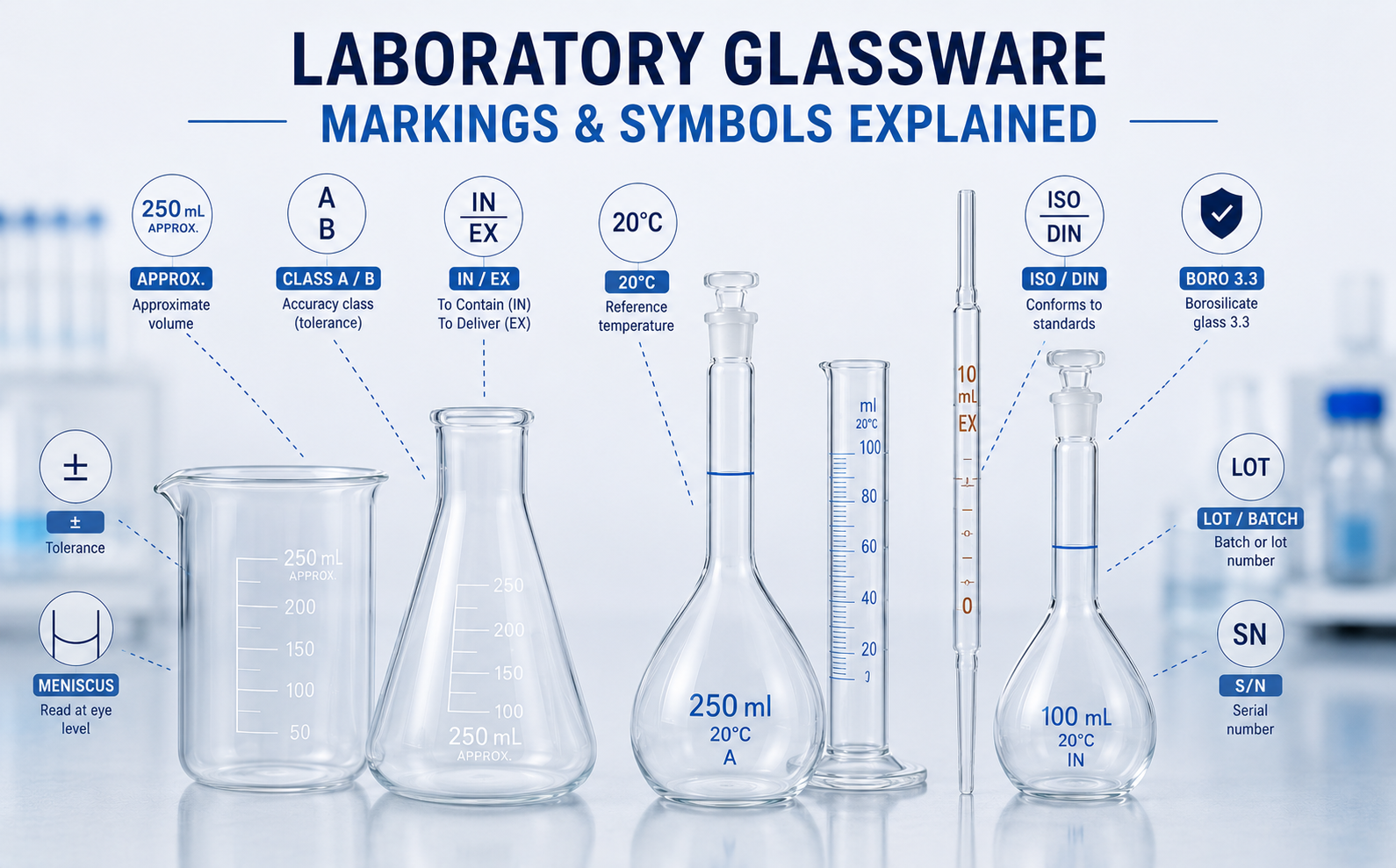
Certificates and technical documents provide essential information about the identity, material, standards, tolerances, calibration and technical performance of laboratory glassware. However, not every certificate serves the same purpose.

Identify the Document First
Common documents include:
- Technical Data Sheet (TDS)
- Certificate of Conformity (CoC)
- Batch / Lot Certificate
- Calibration Certificate
- Individual Certificate
- Declaration of Conformity (DoC)
- Test Report
A Certificate of Conformity, for example, should not automatically be interpreted as an individual calibration certificate.
1. Check Product Identification
Compare the:
Product Name + Product Code + Capacity/Size
with the physical product.
Similar product names are not sufficient if catalogue numbers differ.
2. Verify the Batch / Lot Number
For batch-specific documentation:
Lot on product = Lot on certificate
This creates an important traceability link between the product and its documentation.
3. Check the Glass Type
Look for a clear material description such as:
Borosilicate Glass 3.3
Rather than relying only on general terms such as “laboratory glass.”
4. Read Standards Carefully
ISO, DIN, ASTM or other standards may be referenced.
Check whether the document says:
“Complies with”, “According to”, or merely references a test method.
Mentioning a standard does not necessarily prove compliance with every requirement of that standard.
5. Understand Class A, AS and B
These classes relate to tolerances and other requirements defined by the applicable volumetric glassware standard.
Class A generally has tighter volumetric tolerances than Class B.
Importantly:
Class A ≠ Individual Calibration Certificate
6. Check Nominal Volume and Tolerance
A marking of 100 mL represents nominal capacity.
The acceptable deviation is defined by the relevant tolerance.
For accurate work, both nominal capacity and tolerance should be considered.
7. Understand IN/EX and TC/TD
IN / TC – To Contain: calibrated to contain the stated volume.
EX / TD – To Deliver: calibrated to deliver the stated volume under defined conditions.
This distinction is particularly important for volumetric flasks, pipettes and burettes.
8. Check Reference Temperature
Volumetric glassware is commonly referenced to a defined temperature, often:
20 °C
A marking such as:
100 mL – Class A – IN – 20 °C
provides several important pieces of technical information.
9. Evaluate Calibration Results
A calibration certificate should be evaluated for information such as:
- Product identification
- Calibration date
- Method
- Measured result
- Measurement uncertainty
- Reference standards
- Metrological traceability
The title “Calibration Certificate” alone is not enough.
10. Check Measurement Uncertainty
A result such as:
100.03 mL ± 0.02 mL
contains more information than the measured value alone.
The certificate should provide sufficient information to interpret the stated uncertainty.
11. Batch vs Individual Certificate
A Batch Certificate relates to a defined production batch or batch-control system.
An Individual Certificate relates to a specifically identified item.
The appropriate certificate depends on the laboratory's intended use and quality requirements.
12. Check Dates
Do not confuse:
Manufacturing Date
Test Date
Calibration Date
Certificate Issue Date
They represent different events.
13. Who Issued the Certificate?
A document may be issued by the manufacturer, an internal QC laboratory, an independent laboratory or an accredited calibration laboratory.
These are not technically equivalent.
When accredited calibration is required, the relevant accreditation scope should also be checked.
14. Read the Technical Data Sheet
Depending on the product, a TDS may include:
- Glass material
- Thermal expansion
- Hydrolytic resistance
- Chemical resistance
- Temperature recommendations
- Dimensions
- Joint sizes
These properties help determine whether the product is suitable for a particular application.
15. Understand Technical Terminology
Typical Value: Representative value, not necessarily a guaranteed specification.
Specification: Defined acceptance requirement.
Measured Value: Actual test result.
Tested According To: Indicates a test method was used; it does not necessarily mean complete conformity with every requirement of the referenced standard.
Quick Checklist
Before accepting technical documentation, ask:
✓ Is the document type correct?
✓ Does the product code match?
✓ Does the lot number match?
✓ Is the glass type specified?
✓ Is the applicable standard identified?
✓ Are class and tolerances clear?
✓ Is IN/EX stated where relevant?
✓ Is the reference temperature stated?
✓ Are calibration results and uncertainty available when required?
✓ Is the issuing organization clearly identified?
Conclusion
The key question is not simply:
“Does this product have a certificate?”
It is:
“What type of certificate is it, what does it actually demonstrate, and does it match the product in hand?”