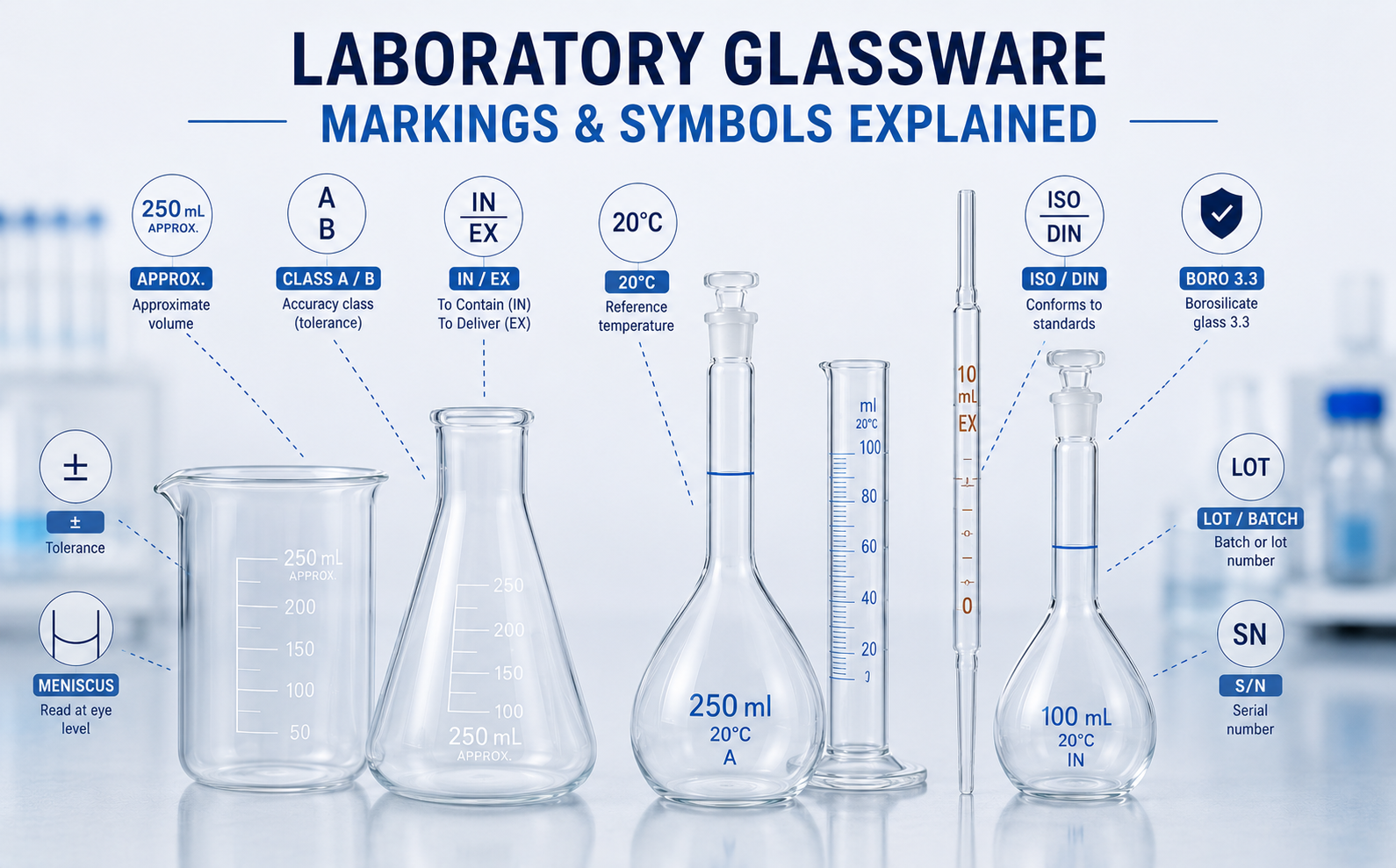
Laboratory glassware comes into direct contact with acids, bases, salt solutions, organic solvents and numerous reagents. Therefore, when selecting a beaker, Erlenmeyer flask, laboratory bottle or other glass vessel, chemical resistance is an important consideration alongside thermal and mechanical properties. Chemical resistance refers to the ability of glass to maintain its surface integrity, structure and essential properties when exposed to specific chemicals under defined conditions. No type of glass, however, is universally resistant to every chemical under all conditions.

What Is Chemical Resistance?
When glass comes into contact with a chemical, interactions may occur at its surface.
Depending on the chemical and exposure conditions, these interactions may eventually cause:
- surface attack,
- clouding,
- surface changes,
- ion release,
- corrosion,
- reduced mechanical strength.
Chemical resistance therefore means more than simply whether the glass visibly dissolves. The stability of the glass surface in the chemical environment must also be considered.
Chemical Resistance of Borosilicate 3.3 Glass
Borosilicate 3.3 glass is one of the most widely used materials for laboratory glassware.
Its high resistance to a broad range of chemicals makes it suitable for beakers, Erlenmeyer flasks, laboratory bottles, burettes, pipettes and many other products.
Its good resistance to water and many acidic environments is particularly valuable in laboratory applications.
However, borosilicate glass is not completely inert to every chemical.
Resistance to Acids
Borosilicate laboratory glass offers high resistance to many acid solutions.
One important exception is hydrofluoric acid (HF).
Hydrofluoric acid reacts with silica-containing glass and can severely attack its surface. Standard glass laboratory vessels should therefore not be used for HF.
Resistance to Alkalis
Strong alkaline solutions require particular attention.
Highly concentrated strong bases, especially when combined with elevated temperatures and prolonged contact, can attack glass surfaces.
For substances such as sodium hydroxide (NaOH) and potassium hydroxide (KOH), three factors should be considered together:
concentration + temperature + contact time.
Suitability for short-term laboratory handling does not automatically mean suitability for long-term storage.
Resistance to Organic Solvents
Borosilicate glass is compatible with many commonly used organic solvents and is therefore widely used for solvent handling, reactions and sample storage.
However, compatibility must be assessed for the entire container system.
Caps, seals, septa, stopcocks and fittings may be made from polymers or elastomers with very different chemical resistance from the glass itself.
What Factors Affect Chemical Resistance?
Chemical resistance depends on several factors:
1. Type of Chemical
The chemical nature of the acid, base, salt or solvent is fundamental.
2. Concentration
Dilute and concentrated solutions of the same chemical may behave differently.
3. Temperature
Higher temperatures can accelerate chemical interactions and surface attack.
4. Contact Time
Short-term contact and long-term storage are very different conditions.
5. Type of Glass
Borosilicate, soda-lime and other glass compositions have different chemical properties.
6. Surface Condition
Scratched, worn or previously attacked glass may behave differently from an undamaged surface.
What Is Hydrolytic Resistance?
Hydrolytic resistance describes the resistance of glass to the release of soluble components when in contact with water.
High hydrolytic resistance is particularly important for analytical applications, solution preparation, sample storage and other sensitive laboratory procedures.
The high hydrolytic resistance of borosilicate 3.3 is one reason for its widespread laboratory use.
Why Does Chemical Resistance Matter for Contamination?
Chemical attack may affect more than the glass itself.
Components released from the glass surface can potentially become a source of contamination in sensitive applications.
This is particularly relevant in trace analysis, analytical chemistry, high-purity solutions, pharmaceutical work and long-term sample storage.
Container selection should therefore consider not only whether a chemical can damage the vessel, but also whether the container could affect sample integrity or analytical results.
Glass or Plastic?
Glass is the preferred material for many chemicals, while PP, HDPE, PTFE or other polymers may be better for others.
Hydrofluoric acid, for example, should not be stored in standard glass vessels and requires an appropriately compatible material.
Conversely, certain organic solvents may affect some plastics while glass remains suitable.
How Should Chemical Compatibility Be Checked?
Evaluate the complete set of operating conditions:
chemical + concentration + temperature + contact time + container material + closure/seal material.
For aggressive chemicals, elevated temperatures or long-term storage, consult the manufacturer's chemical-resistance information and technical documentation.
Conclusion
Chemical resistance in laboratory glassware describes the ability of glass to maintain its surface and structural properties when exposed to chemicals.
Borosilicate 3.3 glass provides excellent chemical and hydrolytic resistance for a broad range of laboratory applications, but no glass is universally resistant.
Hydrofluoric acid, strong alkalis, elevated temperatures and prolonged exposure require particular attention.