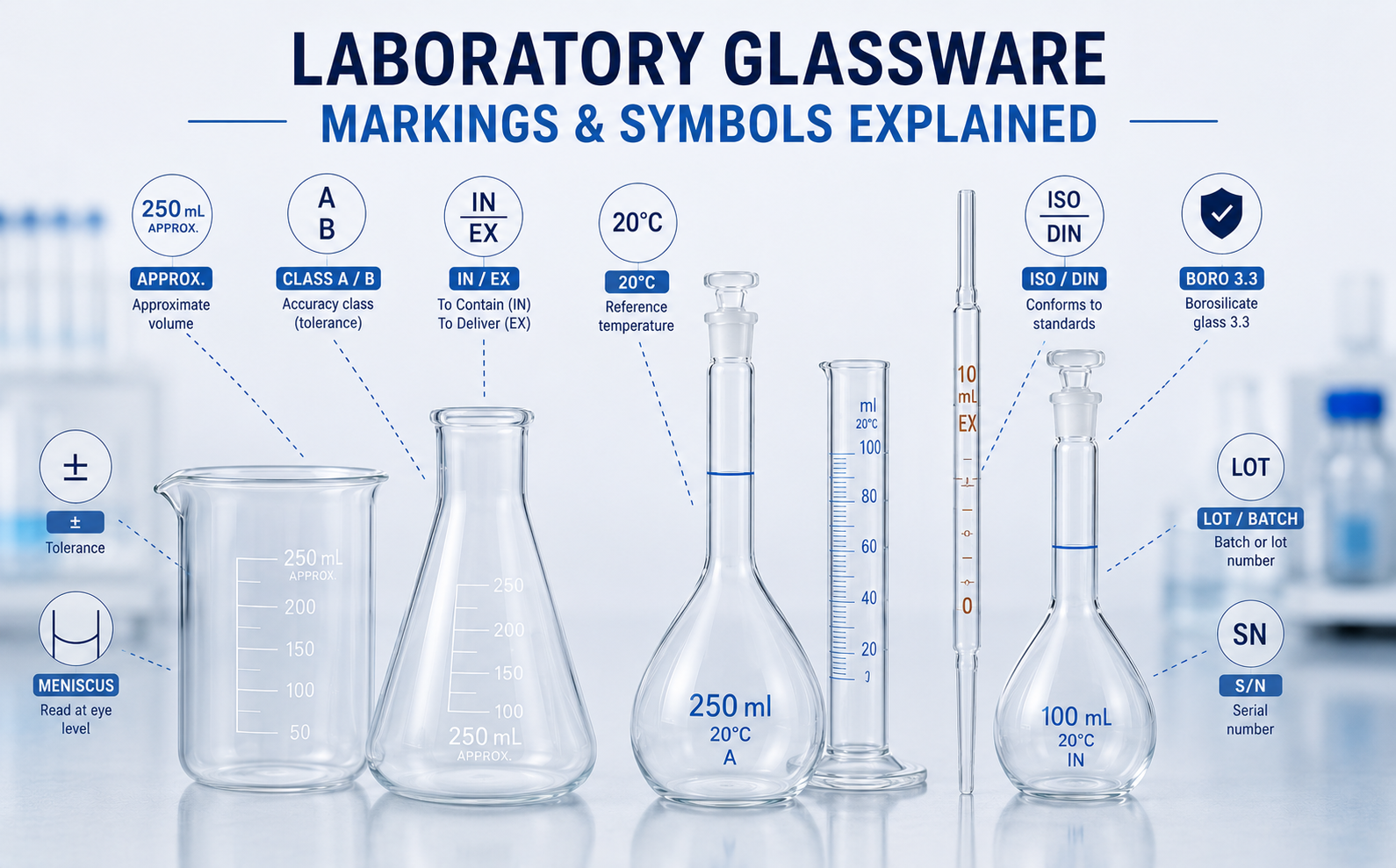
The quality of laboratory glassware is not determined solely by chemical resistance, thermal performance or mechanical strength. Transparency and optical quality are also important because they allow users to observe samples, reactions and the condition of the glassware itself. In beakers, Erlenmeyer flasks, graduated cylinders, burettes, pipettes and laboratory bottles, good transparency makes it easier to observe liquid levels, colour changes, phase separation, precipitation and other changes occurring during laboratory procedures.

What Does Transparency Mean in Laboratory Glassware?
Transparency describes the ability of glass to transmit light so that its contents can be clearly observed.
For laboratory use, good optical quality ideally provides:
- clear visibility,
- uniform appearance,
- minimal unwanted distortion,
- minimal unwanted coloration.
Transparency is therefore more than an aesthetic property—it contributes directly to practical laboratory performance.
1. Observing Colour Changes
Colour changes are important indicators in many chemical procedures.
During a titration, for example, an indicator may change colour near the endpoint.
Clear, colourless glass helps users observe the actual colour of the solution without unnecessary optical interference.
2. Detecting Precipitates and Particles
Transparent glassware can make it easier to identify:
- precipitate formation,
- suspended particles,
- turbidity,
- undissolved material,
- foreign contamination.
This is particularly useful during solution preparation and routine chemical procedures.
3. Monitoring Phase Separation
In liquid-liquid extraction, two immiscible liquids may form separate phases.
Good visibility through a separatory funnel helps the user identify the interface and control phase separation more effectively.
Poor optical quality or contaminated surfaces can make the interface more difficult to observe.
4. Reading Liquid Levels and Menisci
Clear visibility is particularly important for graduated cylinders, burettes, pipettes and volumetric flasks.
Accurate observation of the meniscus supports correct volume readings.
Good practice also requires:
- clean glassware,
- readable graduations,
- suitable lighting,
- appropriate contrast,
- reading at eye level.
Transparency alone, however, does not determine volumetric accuracy. Calibration and tolerance class remain essential.
5. Detecting Foreign Matter
Transparent glass makes visual inspection of solutions easier.
Fibres, crystals, particles, sediment and other unwanted materials may be identified before they affect a laboratory procedure.
6. Inspecting the Glassware Itself
Transparency also helps users inspect the condition of the vessel.
Before use, glassware should be checked for:
- cracks,
- scratches,
- chips,
- damaged edges,
- surface defects,
- residues or contamination.
Such defects can become particularly important when glassware is exposed to heating or mechanical stress.
Are Bubbles Always Defects?
Small bubbles can occasionally occur during glass manufacturing. Their presence does not automatically mean that the product is unsuitable.
The significance depends on the bubble's:
- size,
- position,
- number,
- intended application.
Large or critically located defects may affect optical quality and, depending on their nature, product performance.
Optical Distortion
Irregularities in glass can distort the appearance of objects viewed through the vessel.
Excessive distortion may make it more difficult to observe liquid levels, particles or subtle changes in a sample.
Consistent manufacturing quality therefore contributes to better visual performance.
Borosilicate 3.3 and Optical Appearance
Borosilicate 3.3 is widely used for laboratory glassware because it combines:
- high chemical resistance,
- high hydrolytic resistance,
- low thermal expansion,
- good thermal shock performance,
- suitable transparency for laboratory observation.
These properties make it a versatile material for many laboratory applications.
How Does Cleaning Affect Transparency?
Even high-quality glass can lose visual clarity if it is not cleaned correctly.
Deposits may include:
- water spots,
- chemical residues,
- oils,
- detergent residues,
- mineral deposits.
Proper washing, rinsing and drying are therefore important for maintaining clear glass surfaces.
Is Transparent Glass Suitable for Every Application?
No.
Some chemicals are sensitive to light and may undergo degradation or unwanted photochemical reactions.
For these substances, amber laboratory bottles may be preferable to clear glass.
The choice should therefore consider both visibility requirements and the light sensitivity of the sample.
Simple Visual Inspection
| Inspection Point | What to Check |
|---|---|
| Transparency | Excessive haze or coloration |
| Surface | Scratches, cracks and chips |
| Edges | Damage or breakage |
| Interior | Residues and particles |
| Graduations | Visibility and condition |
| Base | Damage and stability |
| Neck / joints | Cracks or deformation |
Does Transparency Alone Indicate Quality?
No.
Laboratory glassware should be evaluated by considering:
glass type + chemical resistance + hydrolytic resistance + thermal properties + mechanical quality + manufacturing quality + optical quality.
Transparency is only one element, but it is an important one for everyday laboratory use.
Conclusion
Transparency in laboratory glassware is more than an aesthetic feature.
Good optical quality helps users observe colour changes, precipitates, particles, phase boundaries and liquid levels, while also making it easier to inspect the glassware for damage.
For this reason, transparency, surface quality and ease of visual inspection should be considered alongside the chemical and thermal properties of laboratory glassware.