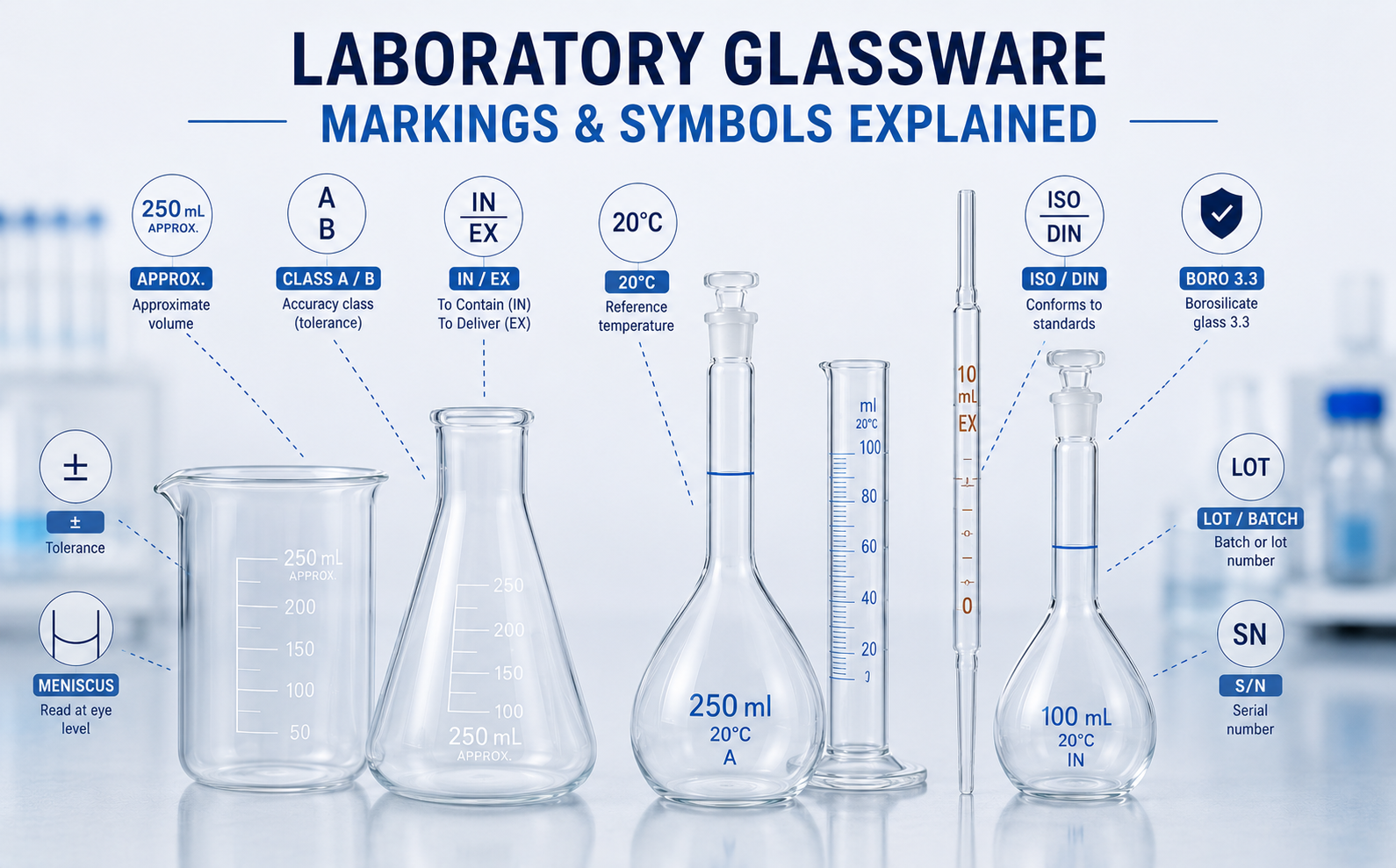
Laboratory glassware is routinely exposed to heating and cooling during reactions, sample preparation and many other laboratory procedures. Borosilicate 3.3 glass is particularly valued for its low thermal expansion and good resistance to temperature changes. However, no laboratory glassware is completely immune to extreme or sudden temperature changes. When different parts of a glass item heat or cool at different rates, thermal stress can develop. If this stress becomes excessive, thermal shock may cause cracking or sudden breakage.

What Is Thermal Shock?
Glass expands when heated and contracts when cooled.
When temperature changes occur relatively uniformly throughout the glass, the resulting stresses are generally lower. If one area changes temperature much faster than another, however, different parts of the glass attempt to expand or contract by different amounts.
This creates internal thermal stress.
If the stress exceeds the strength of the glass, it may result in:
- microcracks,
- visible cracks,
- surface damage,
- sudden breakage.
Therefore, thermal shock depends not only on temperature itself but also on how rapidly and unevenly the temperature changes.
Main Causes of Thermal Shock
1. Placing Hot Glassware on a Cold Surface
A recently heated beaker or flask placed directly on a cold metal, stone or ceramic surface may cool rapidly at its base while the upper sections remain hot.
The resulting temperature gradient can generate significant stress.
2. Adding Cold Liquid to Hot Glassware
Adding a cold liquid suddenly to very hot glassware can rapidly cool the areas that come into contact with the liquid.
Immersing hot glassware in cold water can create an even more severe thermal shock.
3. Heating Cold Glassware Too Quickly
Thermal shock can also occur during heating.
Exposing very cold glassware directly to an intense heat source can cause some areas to expand much faster than others.
4. Uneven Heating
Concentrating heat on a small area of a glass vessel can create substantial temperature differences within the material.
Heating should therefore be as controlled and appropriate to the application as possible.
5. Heating Wet Glassware
Water droplets on the outside of glassware may contribute to localized temperature differences during heating.
The condition of the glass surface should therefore be considered before high-temperature use.
Why Is Borosilicate 3.3 Glass Widely Used?
A significant proportion of high-quality laboratory glassware is manufactured from borosilicate 3.3 glass.
Its low coefficient of thermal expansion means that its dimensional changes with temperature are relatively small, helping it resist thermal stresses more effectively.
For this reason, borosilicate 3.3 is widely used for beakers, Erlenmeyer flasks, boiling flasks, laboratory bottles and reaction vessels.
Nevertheless, high thermal-shock resistance does not mean unlimited resistance.
Does Glass Thickness Affect Thermal Shock?
Yes.
Thick-walled glass can take longer for its internal and external surfaces to reach similar temperatures.
If the outside of a hot, thick-walled vessel is cooled rapidly, it may begin contracting while the interior remains hot.
This can generate significant thermal stress.
Therefore, thicker glass does not automatically mean better resistance to thermal shock.
Why Are Scratches and Microcracks Important?
Scratches, microcracks and impact damage can act as stress concentration points.
Under thermal stress, an existing microscopic defect may grow into a larger crack and ultimately cause breakage.
Glassware intended for heating should therefore be inspected before use.
How Can Thermal Shock Be Prevented?
The fundamental principle is to avoid sudden and uneven temperature changes.
Glassware should be heated and cooled gradually whenever possible. Hot glass should not be placed directly on very cold or wet surfaces.
Other good practices include avoiding the sudden addition of very cold liquids to hot glassware, avoiding intense heating of very cold glass, inspecting glassware for damage before use, selecting glassware suitable for the intended application and following the manufacturer's temperature and handling instructions.
How Should Hot Glassware Be Cooled?
Hot glassware should generally be allowed to cool gradually on an appropriate dry, heat-resistant surface.
The objective is to minimize large temperature differences between different areas of the glass.
Remember that hot glass can look exactly like cold glass. Appropriate handling equipment should therefore be used when necessary.
Can Glassware Be Reused After Thermal Shock?
Glassware with visible cracks, chips or other significant damage should not be used.
If thermal shock is suspected to have caused damage, reheating the item may present an additional risk.
Extra caution is necessary in applications involving pressure, vacuum or elevated temperatures.
Conclusion
Thermal shock is an important cause of laboratory glassware failure. The problem is not simply high temperature, but rapid and uneven temperature changes within the glass.
Borosilicate 3.3 offers excellent thermal performance because of its low thermal expansion, but it still has practical limits.
Controlled heating, gradual cooling, appropriate surfaces and regular inspection are key practices for reducing thermal-shock risks and extending the service life of laboratory glassware.