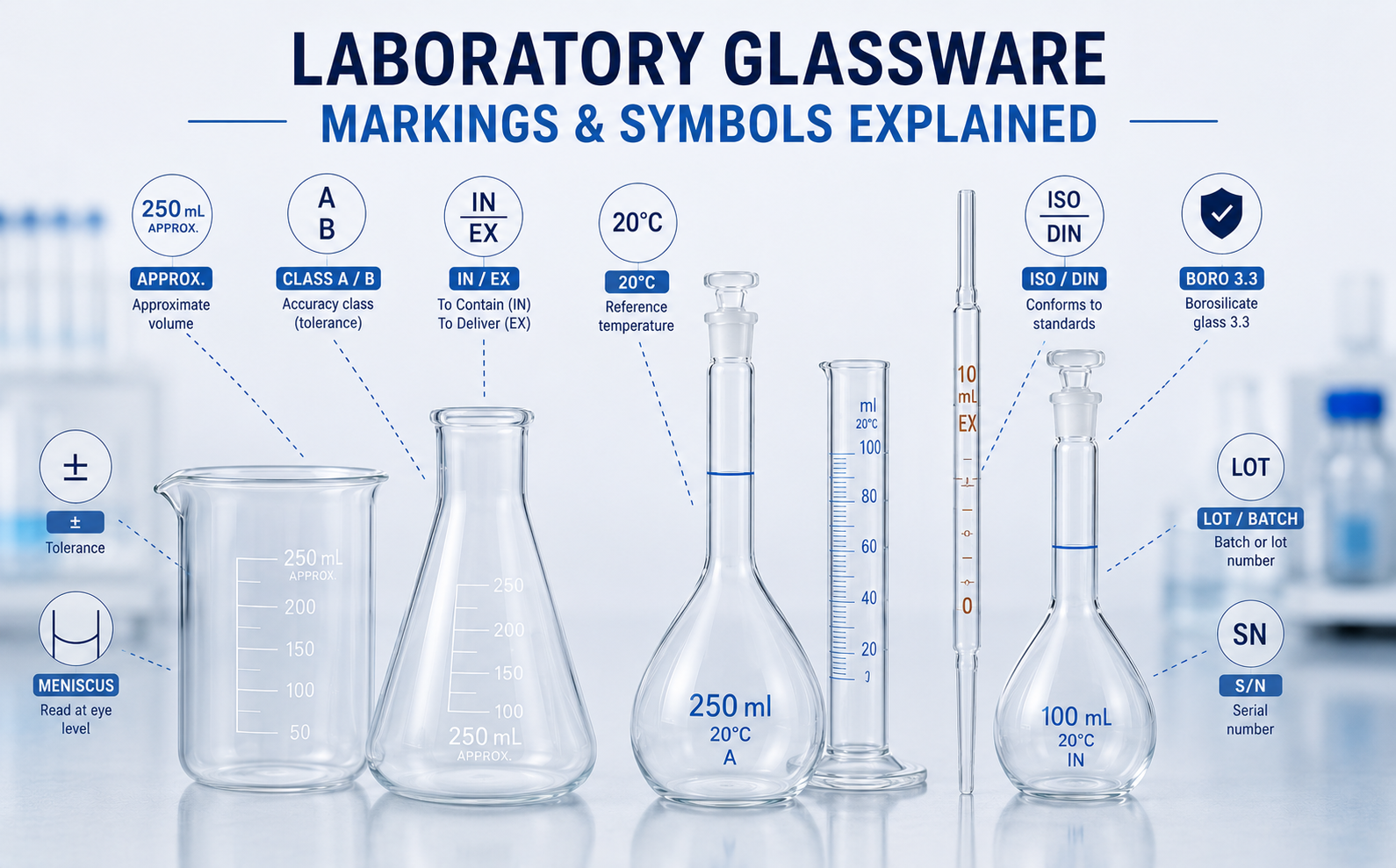
Accuracy in laboratory work depends not only on analytical instruments, but also on the accuracy of the glassware used to measure liquids. Pipettes, burettes, graduated cylinders and volumetric flasks are manufactured for specified nominal volumes. However, a small permitted difference may exist between the nominal and actual volume.

What Is Tolerance in Laboratory Glassware and Why Does It Matter?
Accuracy in laboratory work depends not only on analytical instruments, but also on the accuracy of the glassware used to measure liquids. Pipettes, burettes, graduated cylinders and volumetric flasks are manufactured for specified nominal volumes. However, a small permitted difference may exist between the nominal and actual volume.
This allowable deviation is known as tolerance.
What Is Tolerance?
Tolerance represents the maximum permitted deviation of volumetric laboratory glassware from its nominal volume.
For example, if a 100 ml volumetric flask has a specified tolerance of ±0.10 ml, its calibrated capacity is evaluated within this permitted deviation according to the applicable standard.
The smaller the tolerance, the smaller the permitted volumetric deviation. Tolerance is therefore an important technical criterion when selecting volumetric glassware.
Why Does Tolerance Matter?
Even small differences in volume can affect solution concentration and consequently analytical results.
Appropriate tolerances are particularly important in applications such as titration, standard solution preparation, dilution and quantitative analysis.
Selecting the appropriate tolerance class helps provide reliable volume measurements, supports repeatable analytical results, reduces systematic volumetric errors and facilitates standardized laboratory procedures.
Class A, Class AS and Class B
Volumetric laboratory glassware may be manufactured in different accuracy classes.
Class A is designed for high-accuracy volumetric measurements and generally has tighter tolerances than Class B.
Class AS maintains the high accuracy associated with Class A while, particularly for delivery-type volumetric apparatus, being characterized by shorter delivery and waiting times.
Class B generally permits wider tolerances and may be suitable for routine laboratory applications where the highest analytical accuracy is not required.
Therefore, both the nominal volume and the specified accuracy class should be considered when selecting glassware.
Tolerance and Calibration Are Not the Same
These terms are sometimes confused.
Tolerance defines the maximum permitted deviation. Calibration is the process of comparing the actual volumetric performance of an item with reference values under defined conditions.
In simple terms, tolerance establishes the acceptance limits, while calibration evaluates performance against those limits.
Why Does Temperature Matter?
Volumetric glassware is calibrated at a specified reference temperature, commonly 20 °C.
Because both glass and liquids can change volume with temperature, working temperature may become relevant when evaluating uncertainty in high-precision measurements.
This is why volumetric glassware may carry markings indicating nominal capacity, accuracy class, reference temperature and applicable standards.
Precision with BOROX
BOROX volumetric laboratory products provide solutions for applications ranging from routine laboratory work to precise analytical measurements.
Considering nominal capacity, tolerance, accuracy class, calibration type and the applicable ISO/DIN standard together is an important part of selecting the right volumetric laboratory product.
BOROX – Precision in Every Detail.