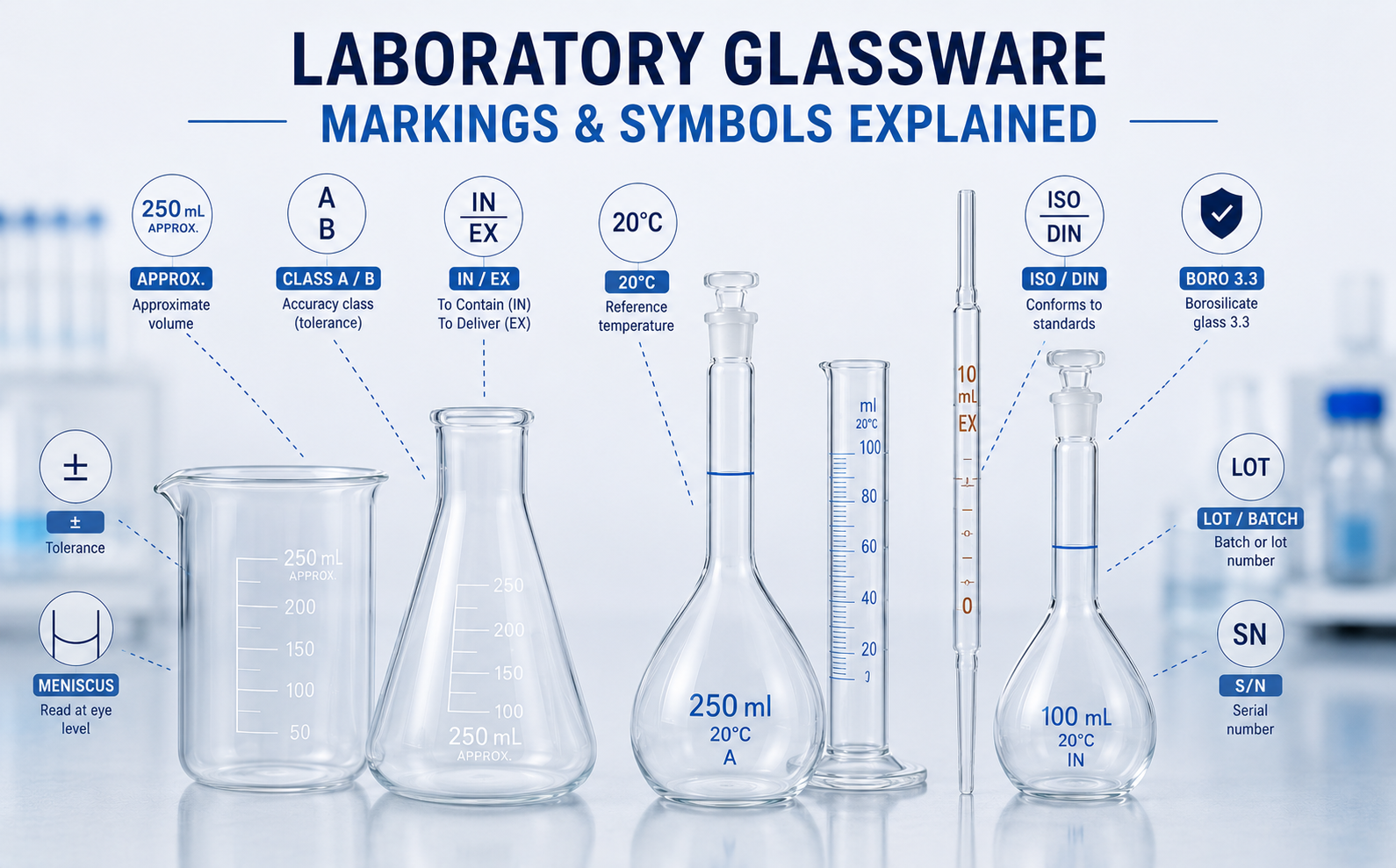
Setting up a laboratory involves much more than choosing the right instruments. Selecting appropriate glassware, plasticware, measuring equipment and consumables is equally important. Poor material choices can increase costs and affect measurement accuracy, repeatability, safety and overall laboratory efficiency. Laboratory products should therefore be selected according to their application, material composition, chemical resistance, temperature conditions, required accuracy and applicable standards.

1. Using the Same Glassware for Every Application
Not all laboratory glassware is designed for the same purpose.
Beakers are excellent for mixing, preparation and general laboratory work, but their graduations are generally not intended for accurate volume measurement.
When precise volumes are required, volumetric glassware such as volumetric flasks, volumetric pipettes or burettes should be selected according to the application.
2. Ignoring the Type of Glass
Similar-looking glass products do not necessarily provide the same performance.
For heating, chemical reactions and applications involving temperature changes, borosilicate 3.3 glass is widely used because of its low thermal expansion and high chemical resistance.
The type of glass should therefore be considered during product selection.
3. Overlooking Class A and Class AS Requirements
Tolerance is an important factor in volumetric measurements.
Routine applications may not always require the highest accuracy class. However, analytical procedures, titrations and accurate solution preparation require appropriately specified volumetric glassware.
For burettes in particular, the differences between Class A and Class AS should be considered according to the required accuracy and application.
4. Not Checking ISO and DIN Standards
Capacity and appearance alone are not sufficient criteria when selecting laboratory products.
Products manufactured according to relevant ISO or DIN standards follow defined requirements regarding dimensions, tolerances, design or performance.
Standards are especially useful when comparing volumetric laboratory glassware.
5. Ignoring Chemical Compatibility
This is particularly important when selecting plastic laboratory products.
Materials such as PP, PE, HDPE and PTFE have different chemical resistance characteristics. Compatibility should be evaluated according to the chemical used, its concentration, contact time, operating temperature and reuse conditions.
Incorrect material selection can affect product lifetime, sample integrity and laboratory safety.
6. Selecting Capacity Based Only on Maximum Volume
Bigger is not always better.
Using oversized glassware for small-volume procedures may make mixing, transferring and sample handling less efficient.
A well-equipped laboratory should therefore include a balanced selection of commonly required capacities.
7. Underestimating Consumables
Large instruments often receive most of the attention during laboratory setup, while everyday consumables may be overlooked.
Pipette tips, filters, tubes, bottles, caps, spatulas and transfer pipettes can all be essential for uninterrupted laboratory operations.
Consumable requirements should therefore be planned alongside permanent equipment.
8. Choosing Products Based Only on Price
The lowest purchase price does not always mean the lowest overall cost.
Products with poor durability, inadequate chemical resistance or unsuitable tolerances may require frequent replacement or negatively affect laboratory procedures.
Quality, specifications, service life, standardization and suitability for the application should therefore be evaluated together.
How Should Laboratory Materials Be Selected?
The key question is not simply “Which product is better?” but rather “Which product is most suitable for this application?”
Considering material type, tolerance class, capacity, chemical compatibility, temperature resistance, frequency of use and applicable standards helps create a safer, more efficient and sustainable laboratory.
The right laboratory starts with the right materials.