Choosing the right laboratory bottle is important for the safe storage of liquids, solutions, reagents, and samples. In addition to volume, closure type, and glass quality, the choice between clear and amber glass should be based on the properties of the substance being stored.
Laboratory Bottles: Clear or Amber?
Choosing the right laboratory bottle is important for the safe storage of liquids, solutions, reagents, and samples. In addition to volume, closure type, and glass quality, the choice between clear and amber glass should be based on the properties of the substance being stored.
Although both types can serve similar purposes, their main difference is their level of protection against light.
Clear Laboratory Bottles
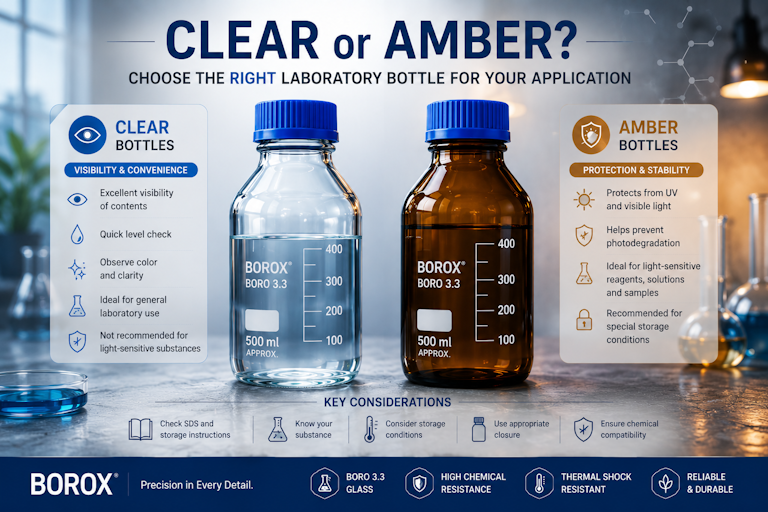
Clear glass bottles provide excellent visibility of their contents. Liquid level, color, clarity, and possible precipitation can be observed without opening the bottle.
They are therefore a practical choice for storing substances that are not sensitive to light.
Main advantages include:
- Easy visual inspection
- Quick monitoring of liquid levels
- Easy detection of color changes or precipitation
- Suitability for general laboratory applications
Amber Laboratory Bottles
Amber glass bottles are preferred for storing light-sensitive substances. Their darker glass helps reduce the transmission of UV and shorter-wavelength visible light into the container.
This is particularly important for chemicals, solutions, and samples that may degrade or change when exposed to light.
Amber bottles can therefore be suitable for light-sensitive reagents, certain organic compounds, indicators, and specialized laboratory solutions.
Clear or Amber?
The decision should primarily depend on the light sensitivity of the substance.
| Feature | Clear Bottle | Amber Bottle |
|---|---|---|
| Content visibility | Excellent | Limited |
| Light protection | Low | Higher |
| General solutions | ✓ | ✓ |
| Light-sensitive substances | Generally not recommended | ✓ |
| Visual inspection | Easy | More limited |
The SDS, technical documentation, and manufacturer's storage recommendations should always be consulted to determine whether a substance requires protection from light.
Glass Quality Matters Too
Color alone does not determine the suitability of a laboratory bottle. The chemical and thermal properties of the glass are equally important.
Borosilicate 3.3 glass used in BOROX laboratory glassware provides low thermal expansion and high chemical resistance, making it a reliable material for many laboratory applications.
Combined with the appropriate closure system, choosing the correct bottle helps protect sample integrity, reduce contamination risks, and support safer laboratory workflows.
Conclusion
A simple selection principle can be applied:
Need visual inspection + substance is light-stable → Clear bottle
Light-sensitive substance → Amber bottle
The right laboratory bottle is more than a storage container—it is an important part of maintaining sample integrity and reliable laboratory practice.
BOROX® — Precision in Every Detail.