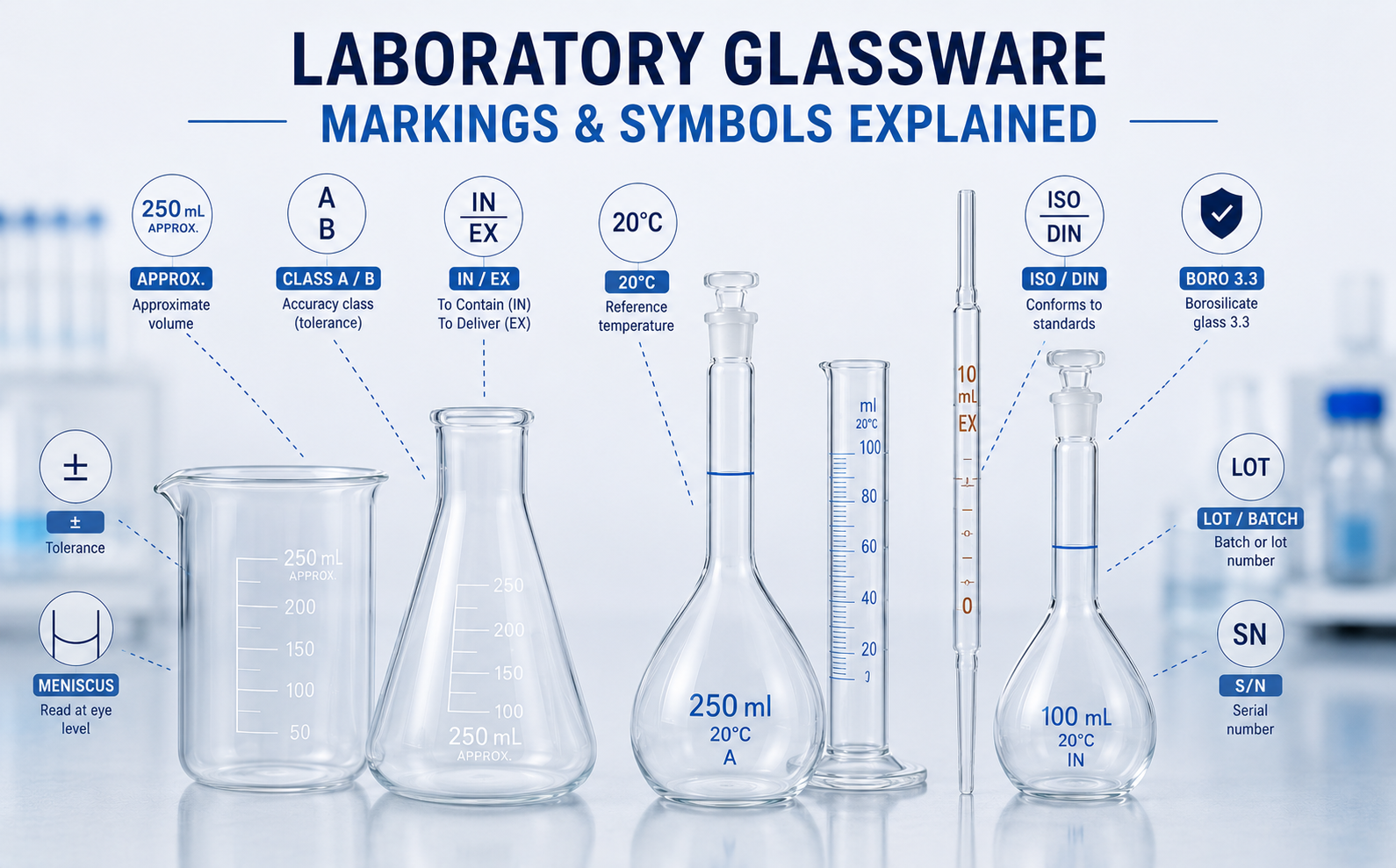
Accurate volume measurement in the laboratory depends not only on high-quality glassware with appropriate tolerances but also on reading the liquid level correctly.

How to Read the Meniscus Correctly: Common Errors in Volume Measurement
Accurate volume measurement in the laboratory depends not only on high-quality glassware with appropriate tolerances but also on reading the liquid level correctly.
In volumetric laboratory equipment such as pipettes, burettes, graduated cylinders and volumetric flasks, the liquid surface is often curved. This curved surface is known as the meniscus.
Incorrect meniscus readings can introduce significant measurement errors, particularly in precise analytical work.
What Is a Meniscus?
When a liquid is contained in a narrow glass vessel, interactions between the liquid and glass can cause the liquid surface to curve.
Water and many aqueous solutions typically form a concave meniscus in glass. In this case, the volume is generally read at the lowest point of the meniscus.
Some liquids, such as mercury, may form a convex meniscus. The appropriate reading method should therefore be selected according to the liquid and applicable procedure.
How Should a Meniscus Be Read?
One of the most important rules is to position your eyes at the same level as the meniscus.
For an accurate reading:
- Keep the glassware in the appropriate upright position.
- Allow the liquid to become stationary.
- Position your eyes at meniscus level.
- For aqueous solutions, align the lowest point of the concave meniscus with the relevant graduation or calibration mark.
- Observe the meniscus and graduation directly from the front.
This technique is particularly important when using burettes, pipettes, graduated cylinders and volumetric flasks.
What Is Parallax Error?
Parallax error is one of the most common errors when reading volumetric glassware.
If the eye is positioned above or below the meniscus, the liquid level may appear to be at a different position relative to the graduation.
The actual liquid volume has not changed, but the observed value can be higher or lower.
For correct measurement, the eye, meniscus and graduation mark should be at the same horizontal level.
Common Volume Measurement Errors
Other factors can also affect measurement accuracy:
- Holding glassware at an incorrect angle
- Taking a reading while the liquid is still moving
- Air bubbles in a pipette or burette tip
- Droplets remaining on the glass surface
- Dirty or greasy glassware
- Selecting an inappropriate capacity or accuracy class
- Working at temperatures significantly different from calibration conditions
In quantitative analyses, several small errors can combine and influence the final result.
Reading a Burette Correctly
With a burette, both the initial and final readings are important.
The delivered volume during titration is determined from the difference between these two readings. Both should therefore be taken consistently and at the correct eye level.
It is also important to remember that burette graduations normally increase downward.
Correct Adjustment of a Volumetric Flask
With a volumetric flask, the solution must be carefully adjusted to the calibration mark.
As the final volume is approached, liquid should be added carefully, preferably drop by drop when necessary. For typical aqueous solutions, the lowest point of the meniscus should coincide with the calibration line when viewed at eye level.
Overfilling should be avoided, as simply removing excess liquid may alter the concentration of the prepared solution.
Correct Glassware + Correct Reading
High-quality volumetric glassware is an important part of measurement accuracy, but it cannot replace correct laboratory technique.
Appropriate tolerance + correct accuracy class + correct meniscus reading + proper technique form the basis of reliable volume measurement.
BOROX volumetric laboratory products provide solutions for measurement requirements ranging from routine laboratory work to precise analytical applications.
BOROX – Precision in Every Detail.