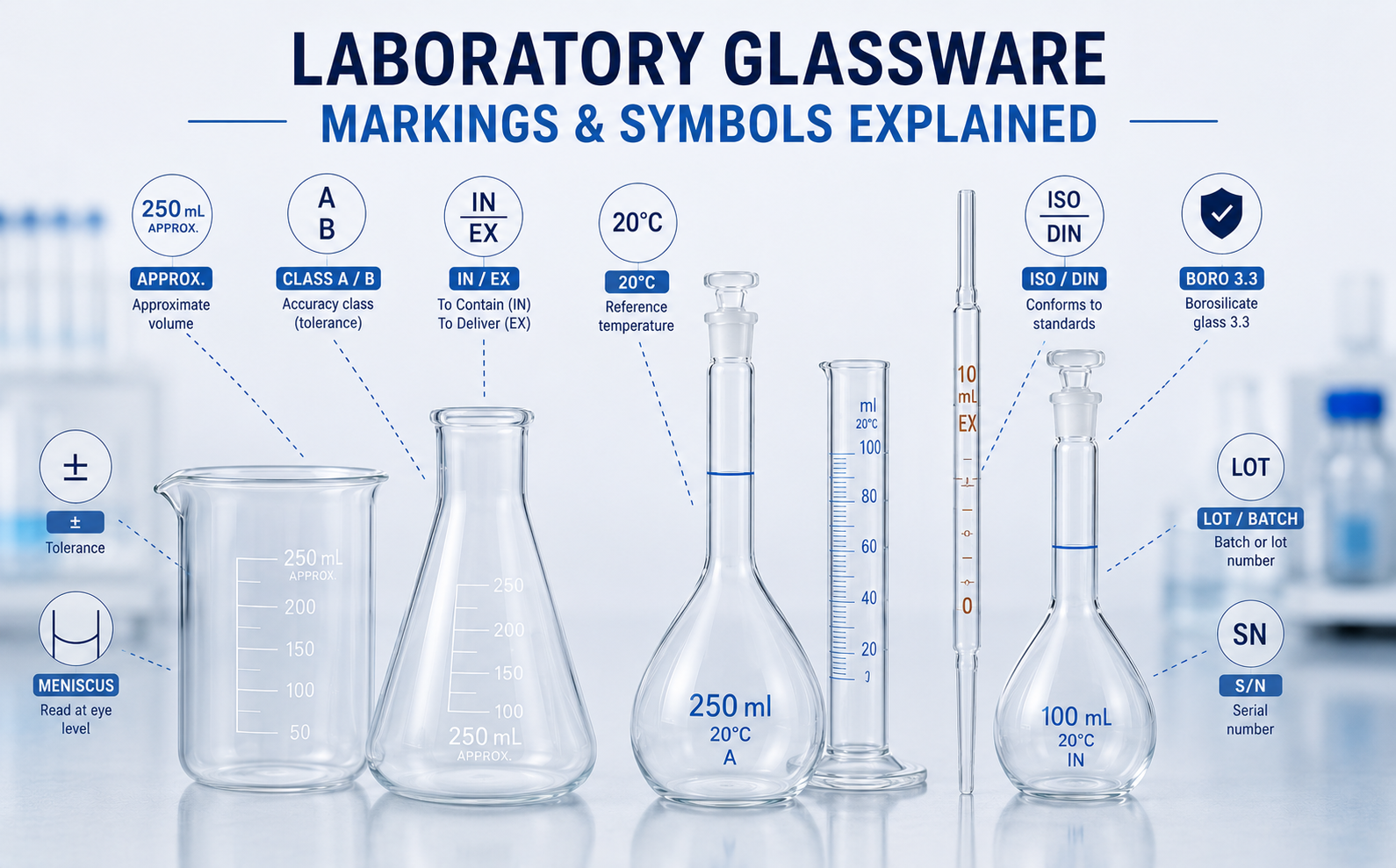
For students entering a laboratory for the first time, beakers, Erlenmeyer flasks, graduated cylinders, volumetric flasks and pipettes may simply look like different glass containers. In reality, each piece of laboratory glassware is designed for a specific purpose. Choosing the correct glassware affects not only convenience but also measurement accuracy, safety and the reliability of experimental results.

1. Beaker
A beaker is one of the most versatile pieces of laboratory glassware. Its cylindrical shape and pouring spout make it suitable for preparing, mixing, heating and transferring liquids.
The graduations on a beaker normally provide only an approximate indication of volume. Beakers should therefore not be used when accurate volume measurement is required.
2. Erlenmeyer Flask
The Erlenmeyer flask has a wide base and narrow neck, making it particularly suitable for mixing liquids by swirling while reducing the risk of splashing.
It is commonly used for solution preparation, chemical reactions and as a receiving flask during titrations.
Its graduations are generally not intended for precise volume measurement.
3. Graduated Cylinder
A graduated cylinder is used when liquid volume must be measured more accurately than with a beaker or Erlenmeyer flask.
For correct measurement, the cylinder should stand on a level surface and the meniscus should be read at eye level.
For highly accurate analytical work, calibrated volumetric glassware should be preferred.
4. Volumetric Flask
A volumetric flask is designed to prepare one specific volume with high accuracy.
It normally has a single calibration mark on its narrow neck. When the meniscus is adjusted to this mark, the flask contains the specified volume.
It is widely used for preparing standard solutions and solutions of known concentration.
Volumetric flasks are generally calibrated In (TC – To Contain).
5. Pipette
Pipettes are designed for accurate measurement and transfer of liquids.
A volumetric pipette delivers one specified volume with high accuracy, while a graduated pipette allows different volumes to be measured and transferred.
For quantitative laboratory work, capacity, tolerance and accuracy class should be considered when selecting a pipette.
6. Burette
A burette is a long graduated glass tube designed for accurate and controlled delivery of liquids.
A stopcock at the bottom allows the flow to be carefully controlled. Burettes are primarily used in titrations, where the delivered volume is calculated from the difference between the initial and final readings.
7. Test Tube
Test tubes are used for holding, mixing and performing reactions with relatively small quantities of materials.
They are common in chemistry, biology and educational laboratories. Depending on their material and design, certain test tubes can also be heated, but their suitability for heating should always be confirmed first.
8. Separatory Funnel
A separatory funnel is designed to separate immiscible liquids based on differences in density.
It is particularly important in liquid-liquid extraction. After the phases separate, the denser lower phase can be released through the stopcock.
9. Glass Funnel
Glass funnels are commonly used to transfer liquids into narrow-neck containers and for filtration when combined with suitable filter paper.
Quick Selection Guide
| Glassware | Main Purpose | Precise Volume Measurement |
|---|---|---|
| Beaker | Mixing, heating, transferring | No |
| Erlenmeyer Flask | Mixing, reactions, titration vessel | No |
| Graduated Cylinder | Volume measurement | Moderate |
| Volumetric Flask | Preparing an exact volume | Yes |
| Volumetric Pipette | Transferring an exact volume | Yes |
| Graduated Pipette | Transferring different volumes | Moderate/High |
| Burette | Controlled dispensing, titration | Yes |
| Test Tube | Small-scale experiments | No |
| Separatory Funnel | Liquid-liquid separation | No |
| Glass Funnel | Transfer and filtration | No |
What Should Students Remember?
Glassware should always be inspected for cracks, chips or other damage before use. Sudden temperature changes should be avoided, and every item should be used only for its intended application.
Correct meniscus reading, choosing appropriate volumetric equipment and understanding accuracy classes such as Class A are fundamental skills for reliable laboratory measurements.
Conclusion
Learning to identify laboratory glassware is one of the foundations of practical laboratory education.
More importantly, students should understand not only what each piece of glassware is called, but why it is designed the way it is and when it should be used. This knowledge contributes to safer experiments, more accurate measurements and more reliable scientific results.