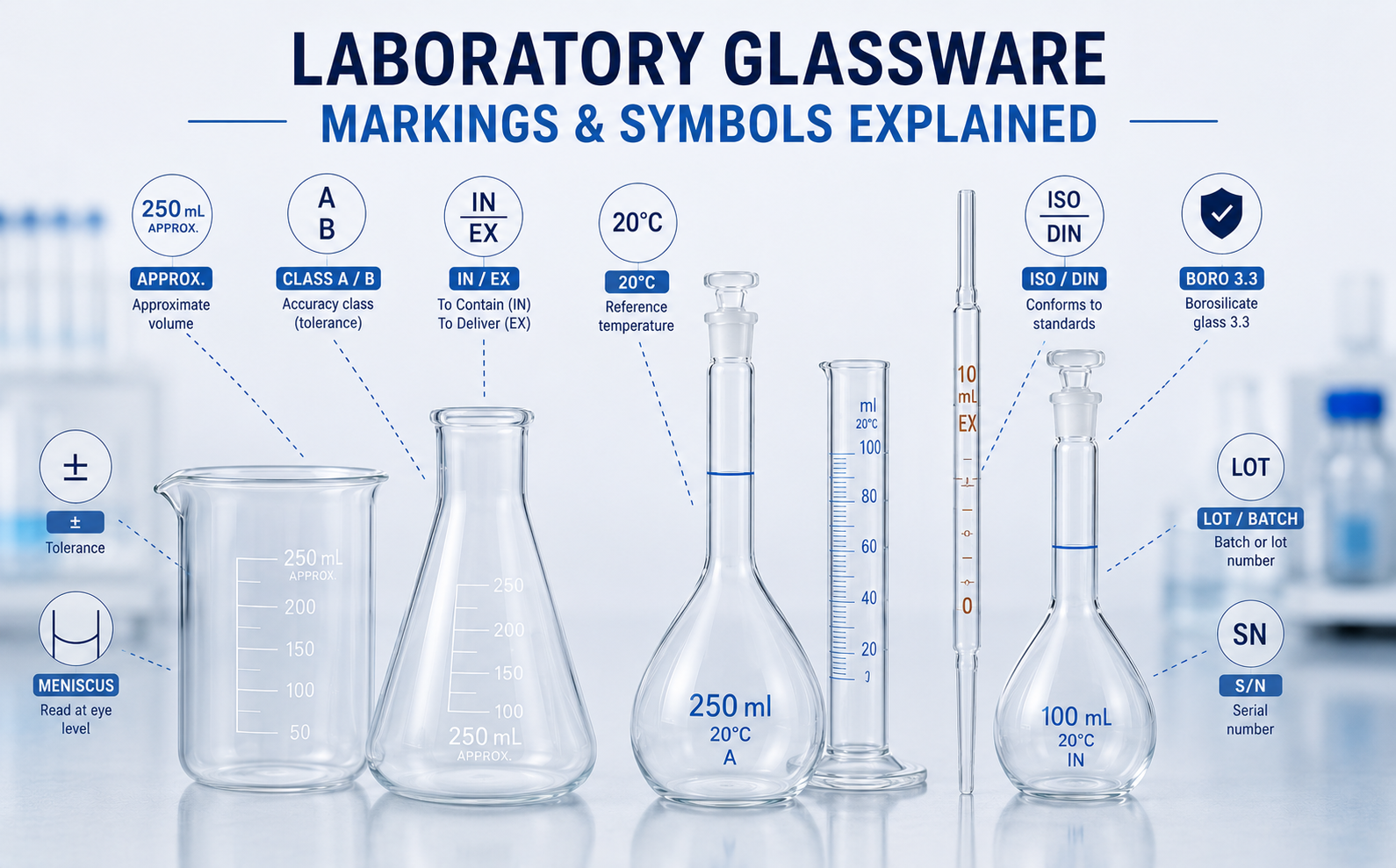
School laboratories provide students with an important environment for learning scientific concepts through practical experiments. Laboratory glassware such as beakers, Erlenmeyer flasks, test tubes, graduated cylinders, volumetric flasks and pipettes plays a fundamental role in many experiments. However, incorrect selection or handling of glassware can create risks including breakage, cuts, chemical splashes and contact with hot liquids. For this reason, selecting appropriate glassware and teaching safe handling practices are equally important.
1. Choose Glassware Suitable for Laboratory Use
Not every type of glass is suitable for laboratory applications. For experiments involving heating, chemical reactions or temperature changes, borosilicate 3.3 glass offers important advantages.
Its low coefficient of thermal expansion provides improved resistance to temperature changes, while its chemical resistance makes it suitable for a wide range of laboratory applications.
Glassware used in educational laboratories should be selected according to its intended application and relevant quality standards.
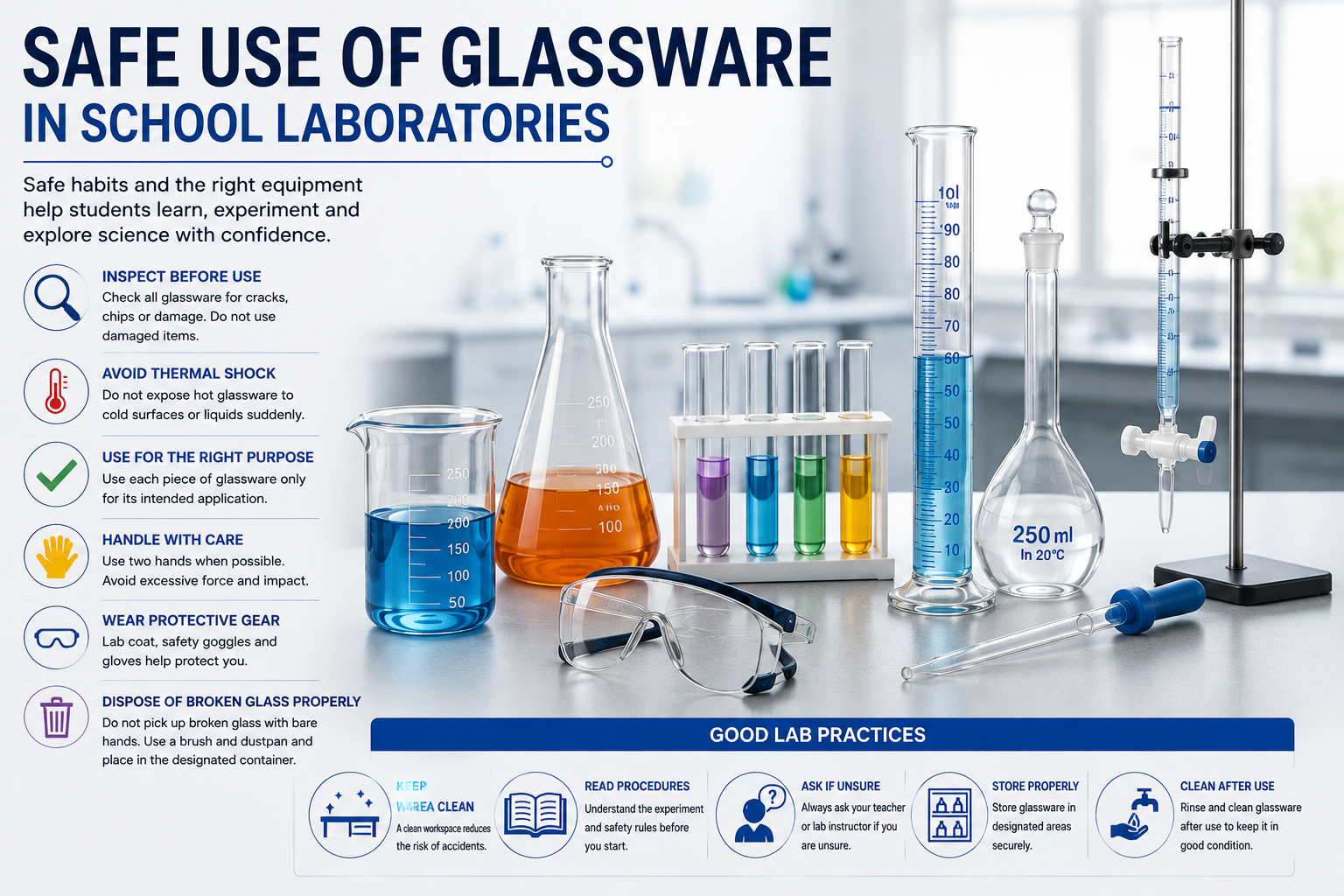
2. Inspect Glassware Before Use
Glassware should always be visually inspected before use. Look particularly for:
- cracks,
- chipped edges,
- scratches,
- damaged rims or joints.
Damaged glassware may break unexpectedly when heated or subjected to mechanical stress. Any questionable item should be removed from use according to laboratory procedures.
3. Avoid Sudden Temperature Changes
Although borosilicate glass offers high thermal resistance, no laboratory glassware is completely immune to thermal shock.
Placing hot glassware directly onto a cold surface or suddenly introducing cold liquid into very hot glassware may create significant thermal stress.
Glassware should therefore be heated and cooled gradually whenever possible.
4. Not All Glassware Is Designed for Heating
It should never be assumed that every glass laboratory product can be directly heated.
Suitable borosilicate beakers and Erlenmeyer flasks may be used for certain heating applications, whereas volumetric flasks, graduated cylinders, pipettes and burettes are generally not intended for direct heating.
Always follow the manufacturer's intended use and applicable laboratory procedures.
5. Use the Right Glassware for the Right Task
Different glassware shapes are designed for different laboratory operations.
Beakers are suitable for mixing, preparation and general laboratory work; Erlenmeyer flasks for mixing and reactions; graduated cylinders for measuring liquid volumes; volumetric flasks for accurate solution preparation; pipettes for controlled liquid transfer; and burettes primarily for titration.
Selecting the correct product improves both laboratory safety and the reliability of experimental results.
6. Use Appropriate Personal Protective Equipment
Appropriate personal protective equipment should be worn when working with laboratory glassware. Depending on the experiment, this may include a laboratory coat, safety glasses and suitable gloves.
Additional precautions may be necessary when handling chemicals, hot liquids, vacuum systems or pressurized applications.
7. Dispose of Broken Glass Correctly
Broken laboratory glass should never be picked up with bare hands or placed in ordinary waste bins.
Fragments should be collected using appropriate tools and placed in a designated, puncture-resistant broken-glass container. Chemically contaminated glass must be handled according to the laboratory's chemical waste procedures.
Safe Laboratory Practice Starts with Education
Laboratory safety is not achieved through equipment alone. Students should learn to identify different types of glassware, understand their intended applications and develop safe working habits.
High-quality glassware selected for the correct application contributes to safer, more controlled and reliable educational laboratory environments.