Accurate volume measurement and liquid transfer are fundamental to reliable laboratory results. Two of the most commonly used types of glass pipettes are volumetric pipettes and graduated pipettes.

Pipette Selection Guide: Volumetric vs. Graduated Pipettes
Accurate volume measurement and liquid transfer are fundamental to reliable laboratory results. Two of the most commonly used types of glass pipettes are volumetric pipettes and graduated pipettes.
Although both are designed for controlled liquid transfer, they differ significantly in measurement principle, accuracy, and flexibility.
What Is a Volumetric Pipette?
A volumetric pipette is designed to deliver one specific nominal volume with high accuracy. It typically has a single calibration mark.
For example, a 10 mL volumetric pipette is intended to accurately deliver its nominal volume under the specified calibration and operating conditions.
Main advantages:
- High accuracy and repeatability
- Precise transfer of a fixed volume
- Suitable for quantitative analysis
- Ideal for standard solution preparation and analytical procedures
Volumetric pipettes are therefore preferred when accuracy is more important than volume flexibility.
What Is a Graduated Pipette?
A graduated pipette has multiple volume markings along its body. This allows different liquid volumes to be measured and transferred within the pipette's specified range.
This makes graduated pipettes particularly versatile for routine laboratory work.
Main advantages:
- Multiple volumes with one pipette
- Practical for routine liquid transfers
- Greater flexibility in general laboratory procedures
- Suitable for repeated operations requiring different volumes
Volumetric or Graduated?
The right choice depends primarily on the required accuracy and flexibility.
| Feature | Volumetric Pipette | Graduated Pipette |
|---|---|---|
| Volume measurement | One nominal volume | Multiple volumes |
| Accuracy | Generally higher | Depends on type and class |
| Flexibility | Lower | Higher |
| Quantitative analysis | Highly suitable | Application-dependent |
| Routine transfer | Suitable | Highly suitable |
| Main purpose | Precise fixed-volume transfer | Variable-volume transfer |
Pay Attention to Calibration Markings
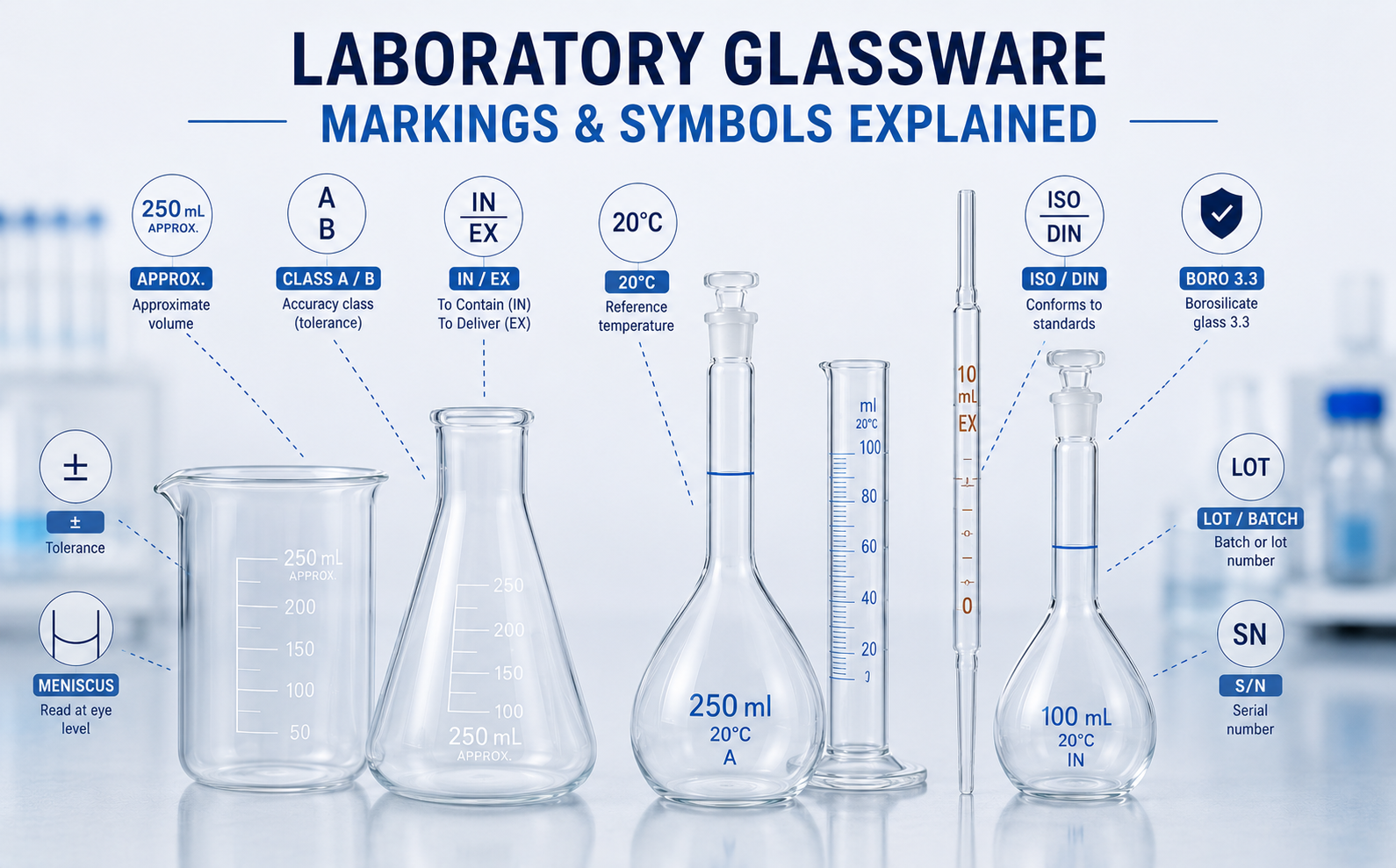
Besides pipette type, users should consider the accuracy class, nominal capacity, tolerance, delivery/drainage characteristics, and applicable standard.
For demanding analytical work, Class A or Class AS pipettes are commonly selected where tighter tolerances are required. For Class AS glassware, the “S” indicates a fast-delivery characteristic with a shorter waiting time as defined by the applicable standard.
Always follow the specific delivery and drainage instructions marked or specified for the pipette.
Correct Meniscus Reading Matters
Even a highly accurate pipette cannot compensate for incorrect technique. The pipette should be held vertically, and for appropriate liquids the meniscus should be read at eye level against the relevant calibration mark.
Parallax errors, incorrect drainage, or improper removal of residual liquid can affect the transferred volume.
Conclusion
A simple selection principle is:
Precise transfer of one fixed volume → Volumetric pipette
Measurement and transfer of different volumes → Graduated pipette
Combining the correct pipette with proper technique, an appropriate accuracy class, and correct meniscus reading helps improve the reliability of laboratory measurements.
BOROX® — Precision in Every Detail.