Laboratory glassware is used in chemical analysis, sample preparation, heating, distillation and countless other procedures. The quality of beakers, flasks, cylinders, burettes, pipettes, reagent bottles and condensers can affect both their service life and laboratory performance. What distinguishes professional laboratory glassware? Here are 7 essential features to consider.

1. High Chemical Resistance
Professional laboratory glassware should resist interaction with many commonly used chemicals, including acids, bases, salt solutions and organic solvents.
Borosilicate 3.3 glass is widely used because of its excellent resistance to many chemicals.
However, no glass is universally resistant. Hydrofluoric acid (HF), for example, attacks silica-containing glass, while strong alkalis can affect glass under severe conditions.
2. High Hydrolytic Resistance
Hydrolytic resistance describes the resistance of a glass surface to interaction with water.
High hydrolytic resistance is particularly important for solution preparation, sample storage and analytical applications.
Standardized methods such as ISO 719 and ISO 720 can be used to characterize the hydrolytic resistance of glass.
3. Low Thermal Expansion and Good Thermal Shock Performance
Laboratory glassware is frequently exposed to changing temperatures.
Borosilicate 3.3 has a linear coefficient of thermal expansion of approximately:
3.3 × 10⁻⁶ K⁻¹
Its low expansion helps improve performance under temperature changes.
Nevertheless, even heat-resistant borosilicate glass should be protected from unnecessary or extreme thermal shock.
4. Uniform and Appropriate Wall Thickness
Wall thickness influences both mechanical and thermal behaviour.
A professionally manufactured product should have a wall thickness appropriate to its design and application, with good uniformity.
Excessive variations can create localized mechanical or thermal stresses.
Importantly, thicker does not automatically mean better. Appropriate and uniform construction is more important.
5. High Transparency and Optical Quality
Transparency allows users to observe:
- colour changes,
- precipitates,
- particles,
- liquid levels,
- phase separation,
- reaction behaviour.
Professional glassware should therefore provide good clarity with minimal unwanted optical distortion.
6. High Manufacturing Quality
Good workmanship is particularly important around:
- rims,
- bases,
- necks,
- hose connections,
- stopcocks,
- ground-glass joints,
- glass joining areas.
Sharp edges, poor joints and excessive deformation can compromise usability and safety.
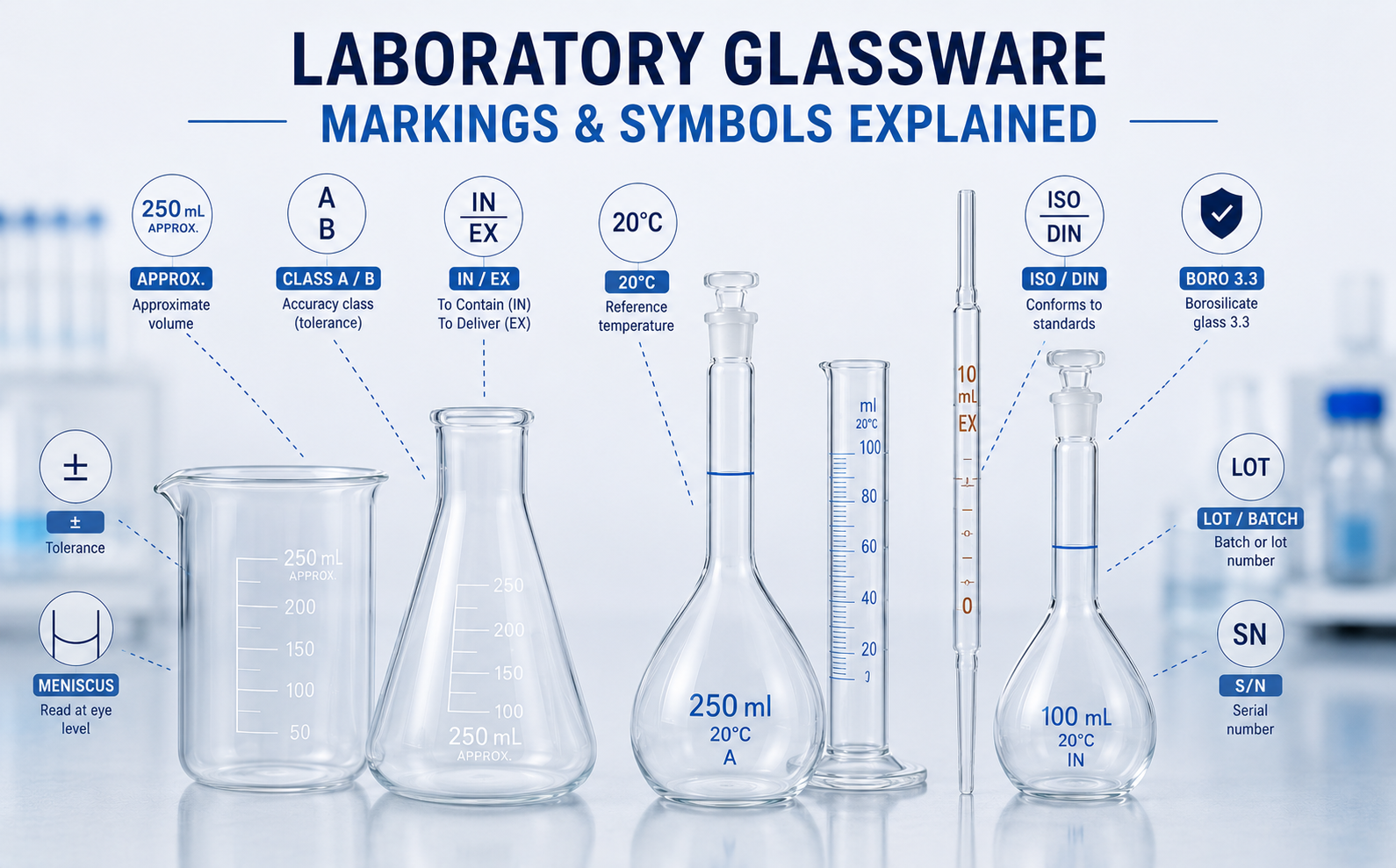
7. Accurate Calibration and Clear Markings
For volumetric glassware, calibration is essential.
Burettes, pipettes, volumetric flasks and graduated cylinders should have clear markings and appropriate accuracy specifications.
Where applicable, products may be manufactured according to defined tolerance classes such as Class A or AS.
Users should therefore evaluate the relevant standard and manufacturer's accuracy specification rather than appearance alone.
The 7 Features at a Glance
| # | Feature | Why It Matters |
|---|---|---|
| 1 | Chemical resistance | Reduces interaction with reagents |
| 2 | Hydrolytic resistance | Important during contact with water |
| 3 | Thermal performance | Supports resistance to temperature changes |
| 4 | Uniform wall thickness | Affects mechanical and thermal behaviour |
| 5 | Transparency | Facilitates visual inspection |
| 6 | Manufacturing quality | Supports safe, reliable use |
| 7 | Calibration and markings | Critical for reliable measurements |
Why Is Borosilicate 3.3 So Common?
Borosilicate 3.3 combines:
low thermal expansion + high hydrolytic resistance + good chemical resistance + excellent transparency
This makes it suitable for a wide range of professional laboratory glassware.
Conclusion
Professional laboratory glassware is much more than simply thick or strong glass.
High-quality products combine chemical resistance, hydrolytic resistance, thermal performance, appropriate wall thickness, optical clarity, good workmanship and reliable calibration.
Selecting glassware based on these characteristics helps support reliable laboratory work and longer product life.