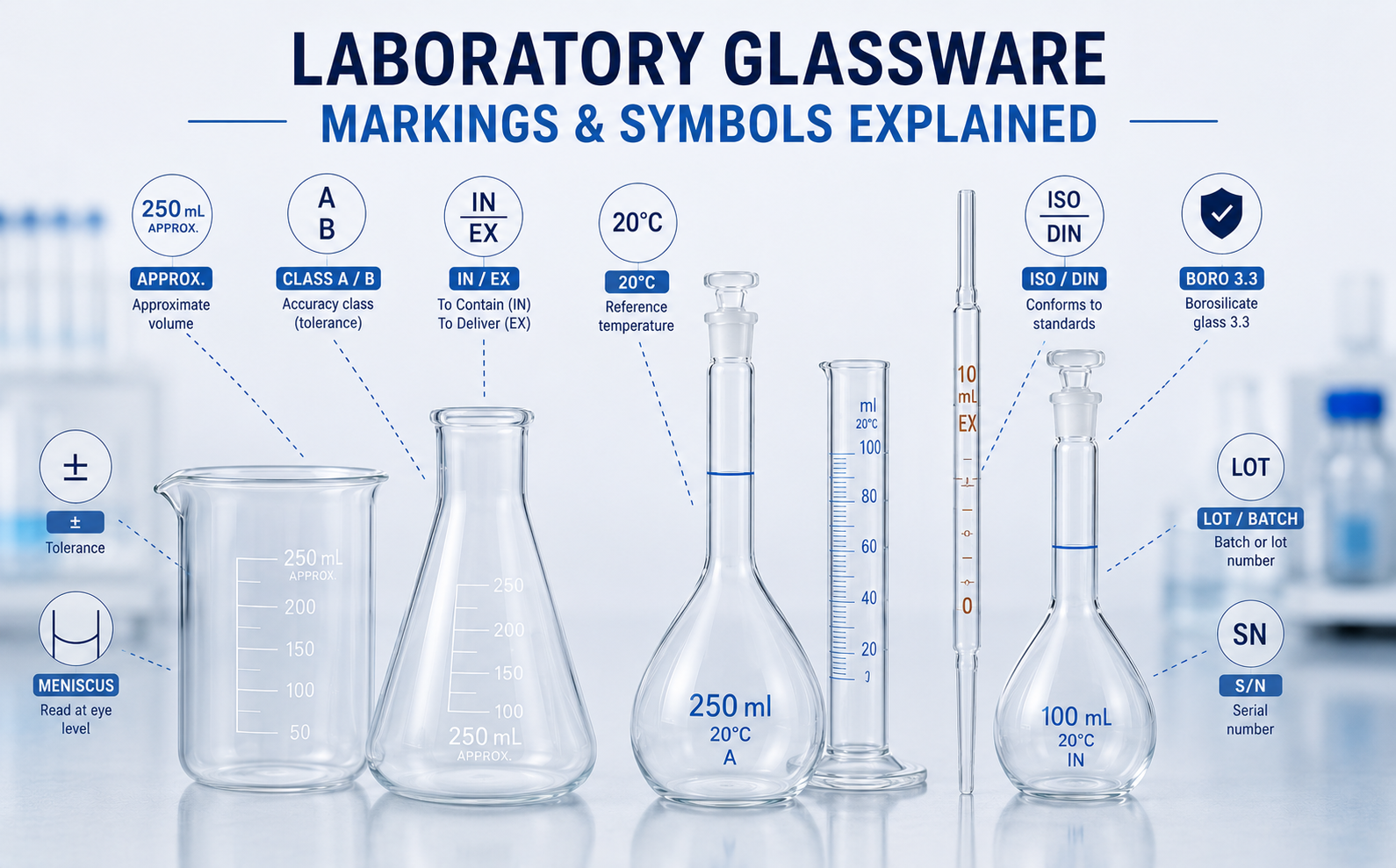
Reagent bottles play an important role in the safe storage and handling of laboratory chemicals. Selecting the correct bottle involves much more than choosing the appropriate capacity. The glass type, bottle colour, closure material, sealing system and chemical compatibility should all be considered together.

Why Does Bottle Material Matter?
The chemical may remain in direct contact with the bottle for extended periods. Selection should therefore consider:
- chemical type and concentration,
- acidic or alkaline nature,
- solvent properties,
- light sensitivity,
- storage temperature,
- storage duration,
- closure compatibility.
The bottle and closure should be considered as one complete storage system.
Borosilicate 3.3 Reagent Bottles
Borosilicate 3.3 is widely used for laboratory reagent bottles because it offers:
- high hydrolytic resistance,
- high resistance to many chemicals,
- low thermal expansion,
- good thermal shock performance,
- excellent visibility.
However, no glass is universally resistant to every chemical.
Clear or Amber Glass?
Clear glass allows easy observation of liquid level, colour, precipitation and visible contamination.
Amber glass is useful for light-sensitive substances because it can reduce transmission of certain wavelengths of light.
Storage requirements in the chemical's SDS or technical documentation should always be considered.
Why Is Closure Selection Important?
A closure may be exposed to chemical vapours even when it is not in direct contact with the liquid.
An incompatible closure material may:
- swell,
- crack,
- soften,
- deform,
- lose sealing performance.
Closure compatibility is therefore just as important as glass compatibility.
PP Closures
Polypropylene (PP) is widely used for laboratory bottle closures because it provides good resistance to many chemicals, low weight and good mechanical performance.
However, PP is not equally resistant to every chemical or solvent. Compatibility should be checked for the specific substance and storage conditions.
PTFE Components and Liners
PTFE (polytetrafluoroethylene) offers excellent resistance to a very broad range of chemicals.
PTFE-faced liners or contact surfaces may therefore be used when greater chemical resistance is required.
The performance of the complete closure system must still be considered.
Why Are Liners Important?
A liner between the bottle neck and closure can help:
- improve sealing,
- reduce vapour loss,
- limit direct contact with the closure,
- improve storage performance.
PTFE, PE and various elastomeric materials may be used depending on the application.
Sealing Performance
For volatile chemicals, effective closure is particularly important.
Poor sealing can contribute to:
evaporation → concentration changes → contamination → vapour release
However, a tightly sealed reagent bottle should not automatically be considered pressure-rated. Standard reagent bottles should not be used for pressurized storage unless specifically designed for it.
Bottle Threads
Standardized laboratory bottle threads, including various GL-type systems, can improve closure and accessory compatibility.
Nevertheless, compatibility should always be confirmed rather than assumed solely from apparent dimensions.
Acids
Borosilicate glass provides good resistance to many acids.
A major exception is hydrofluoric acid (HF), which attacks silica-containing glass.
HF should therefore be stored in an appropriate compatible container rather than standard glassware.
Strong Alkalis
Strong alkaline solutions can attack glass, particularly when high concentration, elevated temperature and prolonged exposure occur together.
Long-term storage conditions should therefore be evaluated carefully.
Organic Solvents
For organic solvents, the glass may provide excellent compatibility while the closure or liner may become the limiting component.
Manufacturer compatibility data should be checked for solvents such as acetone, ethanol, toluene, hexane and others.
Autoclaving
Some borosilicate reagent bottles can be autoclaved under appropriate conditions, but both the bottle and closure must be suitable.
A tightly closed bottle may develop internal pressure during heating. Always follow the manufacturer's autoclaving instructions.
Quick Selection Guide
| Application | Key Consideration |
|---|---|
| General laboratory reagents | Borosilicate glass + compatible closure |
| Light-sensitive chemicals | Amber glass |
| Volatile chemicals | Suitable sealing system |
| Organic solvents | Closure and liner compatibility |
| HF | Do not use glass |
| Strong alkalis | Check concentration, temperature and duration |
| Autoclaving | Bottle and closure temperature compatibility |
| Long-term storage | Compatibility of the complete system |
Conclusion
Selecting the correct reagent bottle is not simply a question of glass versus plastic.
A reliable selection considers:
chemical + glass type + bottle colour + closure material + liner + temperature + storage duration.
Borosilicate 3.3 is an excellent choice for many laboratory reagents, while amber glass can provide additional protection for light-sensitive substances. PP, PTFE and other closure materials should be selected according to chemical compatibility.
For critical applications, always evaluate the chemical's SDS together with the bottle manufacturer's compatibility information.