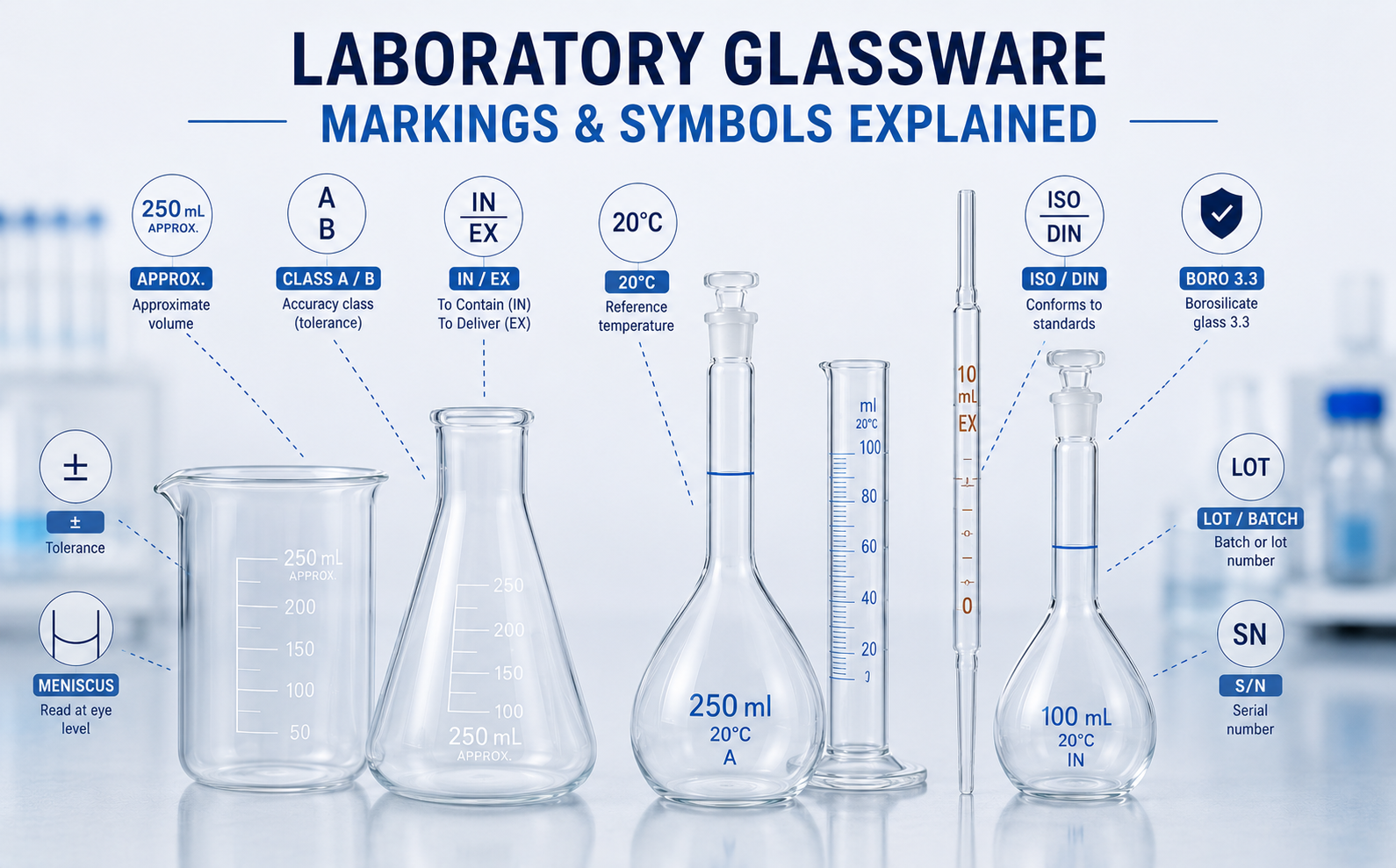
Glassware is an essential part of teaching, research, analytical and experimental work in university laboratories. From beakers and Erlenmeyer flasks to volumetric flasks, burettes and pipettes, each item is designed for a specific purpose. Selecting the right laboratory glassware is important not only for convenience but also for measurement accuracy, chemical resistance, safety and experimental reproducibility.

Why Is the Right Glassware Important?
The same university laboratory may support basic student experiments as well as advanced research. Glassware should therefore be selected according to technical requirements rather than shape or capacity alone.
Important criteria include:
- Intended application
- Type of glass
- Chemical and thermal resistance
- Volumetric accuracy and tolerance
- Class A / AS or Class B classification
- Relevant ISO and DIN standards
- Heating and sterilization requirements
1. Advantages of Borosilicate 3.3 Glass
Borosilicate 3.3 glass is one of the most important materials for general university laboratory applications.
Its low coefficient of thermal expansion provides good resistance to temperature changes, while its chemical resistance makes it suitable for a broad range of laboratory procedures.
It is commonly used for beakers, Erlenmeyer flasks, laboratory bottles, test tubes, separating funnels and reaction vessels.
However, borosilicate glass should not be considered resistant to unlimited thermal shock or every chemical. Appropriate operating conditions must always be observed.
2. Beakers and Erlenmeyer Flasks
Beakers are widely used for preparing solutions, mixing, heating and transferring liquids.
The conical shape of an Erlenmeyer flask makes swirling and mixing easier while helping reduce splashing.
An important distinction is that the graduations on most beakers and Erlenmeyer flasks are not intended for high-accuracy volumetric measurement.
For accurate volume measurements, volumetric glassware should be used.
3. Graduated Cylinders
Graduated cylinders generally provide more accurate volume measurements than beakers.
They are practical for teaching laboratories and routine solution preparation. For high-precision analytical work, however, volumetric flasks, volumetric pipettes or burettes may be more appropriate.
4. Volumetric Flasks
Volumetric flasks are calibrated to contain a defined volume with high accuracy.
They are therefore essential for:
- Preparing standard solutions
- Dilutions
- Analytical chemistry
- Quantitative laboratory work
For precision applications, the tolerance class and applicable standard should always be checked.
5. Choosing Pipettes
Pipettes should be selected according to the required volume and accuracy.
Volumetric pipettes are designed to transfer one specified volume with high accuracy.
Graduated pipettes allow different volumes to be measured and transferred, providing greater flexibility.
Capacity, tolerance, calibration type and accuracy class are important considerations in analytical applications.
6. Burettes for Titration
Burettes are essential for analytical chemistry and titration procedures.
Important selection criteria include capacity, graduation interval, tolerance, Class A/AS or B classification, stopcock design, flow control and compliance with relevant standards.
High-accuracy burettes should be preferred for precise quantitative analyses.
7. Class A, Class AS and Class B
Accuracy classification is particularly important for volumetric glassware.
Class A provides tighter tolerances for applications requiring higher accuracy.
Class AS combines Class A accuracy with a shorter waiting time for certain volumetric delivery instruments.
Class B generally has wider tolerances and can be a cost-effective choice for educational and routine applications where the highest analytical accuracy is unnecessary.
The classification should always be interpreted together with the relevant product standard.
8. Check ISO and DIN Standards
Relevant ISO and DIN standards may specify requirements concerning dimensions, capacity, tolerances, design and performance of laboratory glassware.
Different standards apply to products such as pipettes, volumetric flasks, burettes and graduated cylinders.
For university procurement and quality systems, it is therefore important to verify which standard the product has been manufactured to.
9. Teaching vs. Research Laboratories
Not every university laboratory requires the same level of accuracy.
Basic teaching laboratories may prioritize durability, ease of use and cost efficiency. Analytical chemistry, pharmaceutical analysis, biochemistry and advanced research laboratories may require tighter tolerances, defined calibration and better traceability.
The purchasing specification should therefore reflect the laboratory's actual application.
Conclusion
Selecting glassware for university laboratories requires more than simply choosing between a beaker, flask or pipette.
Glass type, intended use, volumetric accuracy, tolerance class, chemical and thermal resistance, and compliance with relevant ISO/DIN standards should all be evaluated together.
The right laboratory glassware helps students develop proper laboratory techniques while providing researchers with reliable and reproducible working conditions.