Laboratory flasks are essential pieces of glassware used for chemical reactions, heating, distillation, solution handling and many other procedures. Two common designs are the round-bottom flask (RBF) and the flat-bottom flask. Although the most obvious difference is the shape of the base, this geometry can significantly influence heat distribution, stability, mechanical stress and suitable applications.

Round-Bottom Flask
A round-bottom flask has a spherical or nearly spherical lower body.
It is commonly used for:
- organic synthesis,
- distillation,
- reflux,
- solvent evaporation,
- heated reactions.
Advantages
Its rounded geometry promotes relatively uniform heat distribution and helps distribute thermal and mechanical stresses more evenly.
It is also particularly convenient for integration with condensers, adapters, dropping funnels and other ground-glass components.
Flat-Bottom Flask
A flat-bottom flask has a rounded body with a flattened base.
Its main practical advantage is simple:
it can stand upright on a flat laboratory surface without a supporting ring.
It can be useful for general solution handling, temporary storage and certain mixing procedures.
Key Differences
| Feature | Round-Bottom | Flat-Bottom |
|---|---|---|
| Base | Rounded | Flat |
| Stands independently | No | Yes |
| Heat distribution | More uniform | Geometry-dependent |
| Distillation | Excellent | More limited |
| Reflux | Excellent | Application-dependent |
| Organic synthesis | Very common | Less common |
| Support required | Usually | Not for bench standing |
| Main advantage | Heating and reaction systems | Stability and convenience |
Which Is Better for Heating?
For controlled and intensive heating, round-bottom flasks are generally preferred.
Their curved surface works well with heating mantles, water baths and oil baths while helping distribute heat more uniformly.
The suitability of a flat-bottom flask for heating depends on its specific design and manufacturer's instructions.
Why Are Round-Bottom Flasks Used for Distillation?
Round-bottom flasks combine efficient heating geometry with convenient ground-glass connections.
This makes it easy to connect:
- condensers,
- distillation heads,
- thermometer adapters,
- receiving systems.
For this reason, they are standard components of many laboratory distillation systems.
Which Flask Is Used for Reflux?
Round-bottom flasks are also widely preferred for reflux.
A typical system operates as:
Round-bottom flask → Vapour → Condenser → Condensation → Return to flask
This allows a solvent to boil and continuously return to the reaction mixture.
When Is a Flat-Bottom Flask Useful?
Flat-bottom flasks are particularly useful when bench stability is important.
They can be convenient for:
- temporary solution storage,
- general laboratory preparation,
- certain mixing procedures,
- applications where the vessel must stand independently.
Supporting a Round-Bottom Flask
Because a round-bottom flask cannot stand independently, it should be supported using an appropriate:
- cork ring,
- flask support,
- clamp,
- laboratory stand.
Leaving it unsupported on a bench can cause it to roll and break.
Single-Neck and Multi-Neck Flasks
Round-bottom flasks are available with one, two, three or more necks.
Multi-neck versions can accommodate several components simultaneously, including:
- condenser,
- thermometer,
- dropping funnel,
- gas inlet,
- mechanical stirrer.
This makes them particularly versatile for organic synthesis.
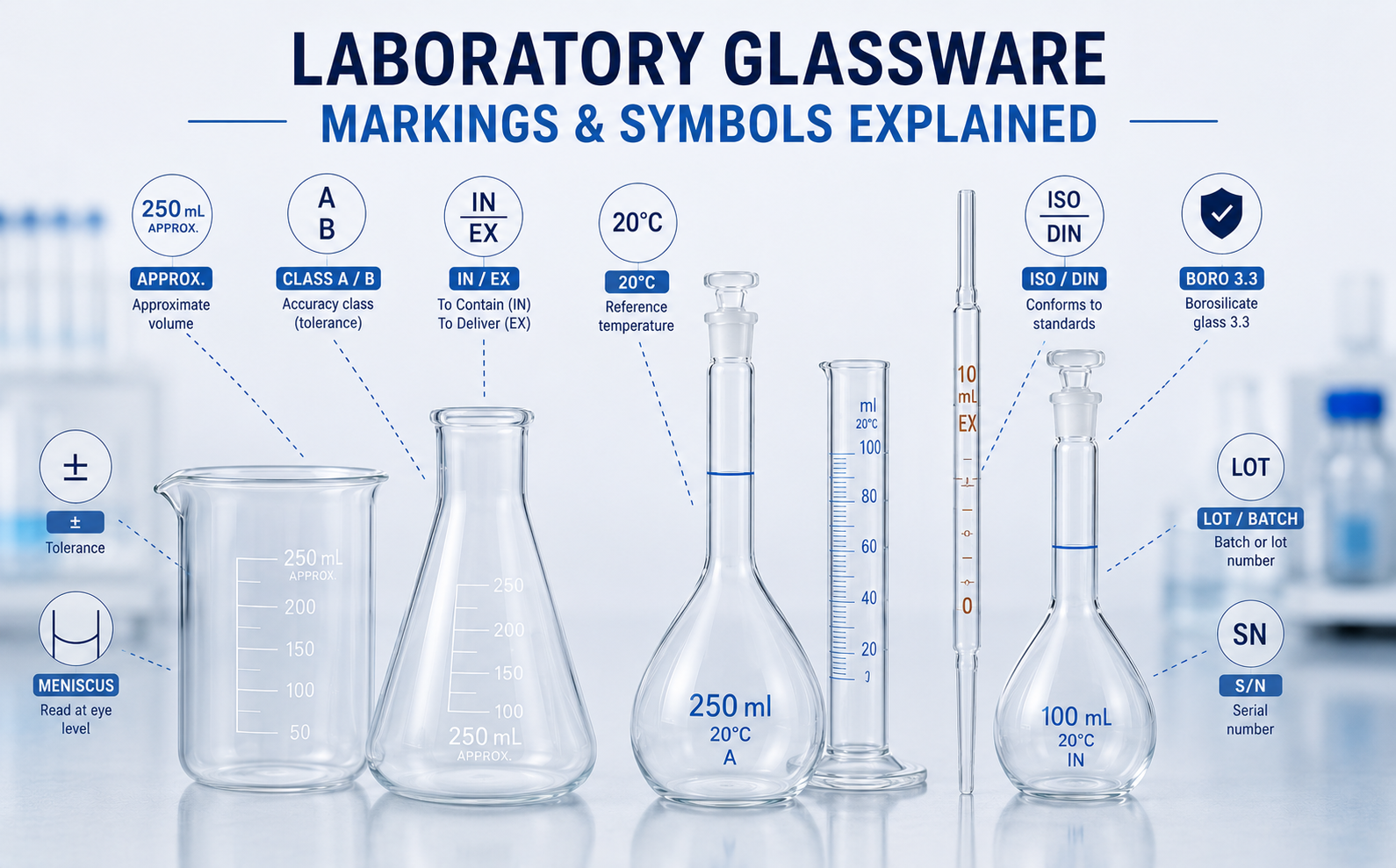
Borosilicate 3.3 Glass
Many laboratory flasks are manufactured from borosilicate 3.3 glass, which provides:
- low thermal expansion,
- good thermal shock resistance,
- high hydrolytic resistance,
- good resistance to many chemicals,
- excellent transparency.
Nevertheless, borosilicate glass is not immune to thermal shock or mechanical damage.
Vacuum Applications
Rounded geometry can distribute external pressure more evenly, but not every round-bottom flask is automatically suitable for vacuum use.
Only glassware specifically approved by the manufacturer for the intended vacuum conditions should be used.
Damaged or scratched glassware should never be subjected to vacuum.
Conclusion
The two designs serve different purposes.
Round-bottom flask → heating, distillation, reflux and organic synthesis
Flat-bottom flask → convenient bench-top stability and general handling
The correct choice should consider glass type, temperature, chemical compatibility, pressure conditions, heating method and experimental setup.