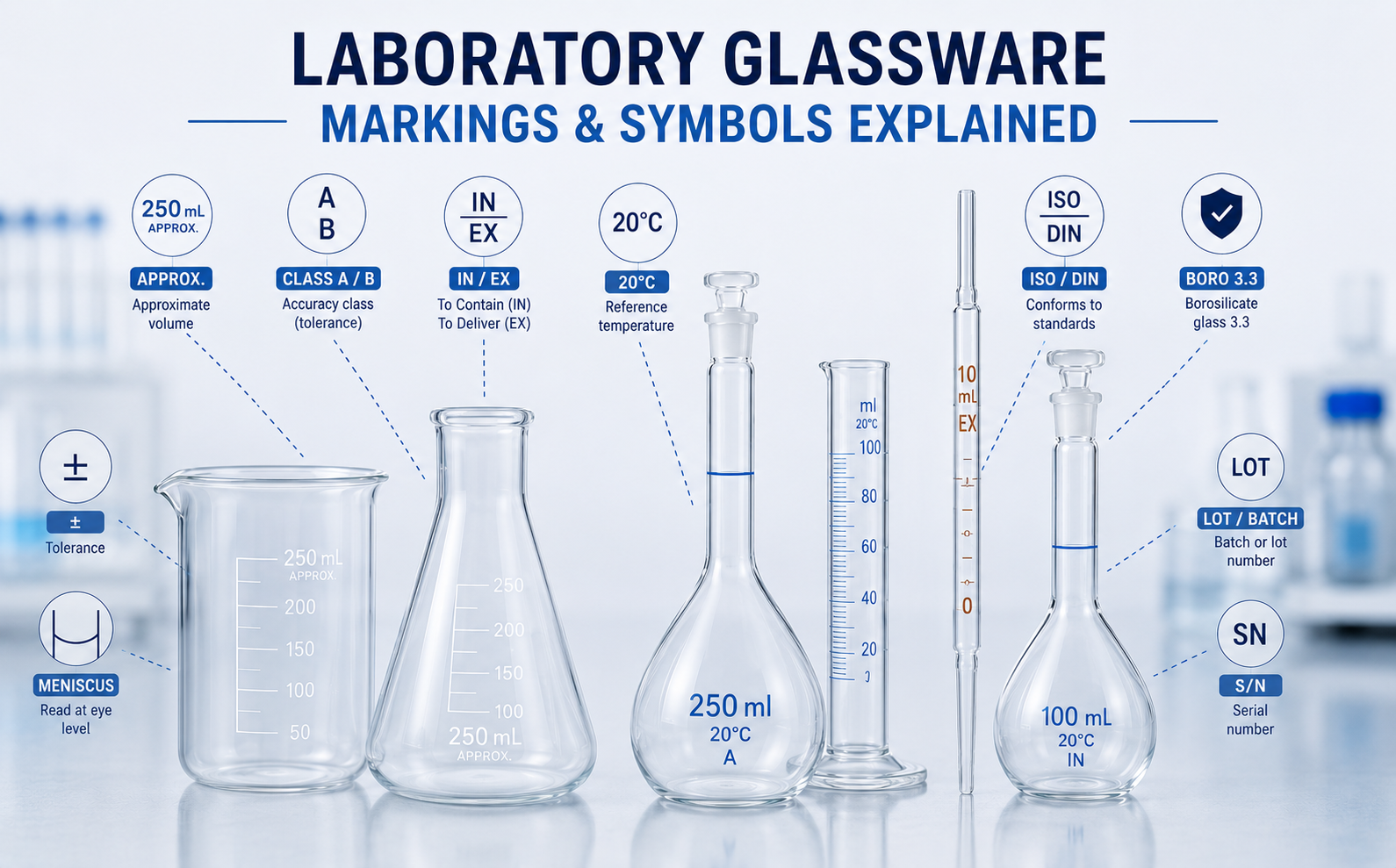
When evaluating laboratory glassware, attention is usually given to glass material, chemical resistance, thermal performance and volumetric accuracy. However, the quality of graduations and technical markings is also important. Markings on beakers, cylinders, burettes, pipettes and volumetric flasks may communicate volume, calibration type, accuracy class, reference temperature and other technical information.

1. Clear Graduations Improve Readability
Graduation lines should be clear, consistent and easy to distinguish.
Poor contrast, irregular lines or excessively thick markings can make volume readings more difficult.
2. Line Thickness Matters
Particularly on volumetric glassware, a well-defined line provides a clearer visual reference for positioning the liquid meniscus.
However, printing quality alone does not determine volumetric accuracy.
3. Contrast Improves Visibility
Good contrast between the glass and its markings helps users read graduations quickly.
The colour itself, however, does not define the accuracy class.
Blue graduations do not automatically mean Class A.
4. Correct Positioning Is Essential
For calibrated volumetric glassware, the position of the calibration mark is technically significant.
A misplaced mark can therefore represent more than a cosmetic defect.
5. Printing and Calibration Are Different
This distinction is essential:
Printing quality = physical and visual quality of the marking
Calibration = relationship between the mark and the actual volume
A perfectly printed 100 mL line does not, by itself, prove that the product meets the required volumetric tolerance.
6. Durability Affects Service Life
Reusable laboratory glassware may undergo repeated:
- washing,
- chemical exposure,
- drying,
- handling,
- and, where appropriate, sterilization.
If the graduations disappear rapidly, the glass may become difficult or unsuitable to use even if the vessel itself remains intact.
7. Chemical Resistance of the Print
The chemical resistance of the glass and the resistance of the printed markings are not necessarily identical.
Cleaning agents, acids, alkalis and solvents may affect markings differently depending on the printing technology.
Manufacturer instructions should therefore be followed.
8. Heat Can Affect Markings
A borosilicate glass vessel may tolerate conditions that its printed markings cannot.
Oven drying, autoclaving or heating should therefore be performed only according to the manufacturer's recommendations for the specific product.
9. Volumetric Glassware Requires Greater Attention
Printing quality is particularly important on:
burettes, pipettes, graduated cylinders and volumetric flasks.
Line thickness, spacing, numbering and contrast all influence ease of reading.
10. Common Printing Defects
Potential problems include:
- faded markings,
- irregular lines,
- excessively thick lines,
- incorrect numbers,
- missing markings,
- peeling print,
- incorrectly positioned calibration marks.
Some are cosmetic, while others may affect correct product use.
What Does Good Printing Look Like?
Professional laboratory glassware should generally have markings that are:
Clear + Readable + Well positioned + Durable + Technically correct
Where relevant, markings such as Class A/B, IN/EX, 20 °C and nominal volume should also be consistent with the product's technical documentation.
Does Print Colour Indicate Quality?
No.
Colour alone does not establish quality or volumetric accuracy.
More important criteria are:
Readability + Accuracy + Position + Durability + Technical correctness
Printing and Traceability
Where lot numbers or other identification markings are applied directly to the product, their durability may also contribute to traceability.
If these identifiers disappear, connecting the product to certificates or manufacturing records may become more difficult.
Conclusion
Printing quality on laboratory glassware is not merely cosmetic.
Good markings help users correctly interpret volume, calibration points, accuracy classes and technical information.
However:
Good printing ≠ Correct calibration
High-quality professional volumetric glassware requires both appropriate marking quality and correct volumetric performance.