
Laboratory glassware often carries much more information than just its brand and capacity. Markings such as Approx., Class A, AS, B, IN, EX, TC, TD, 20 °C, ISO, DIN and LOT provide important information about its intended use and technical characteristics.
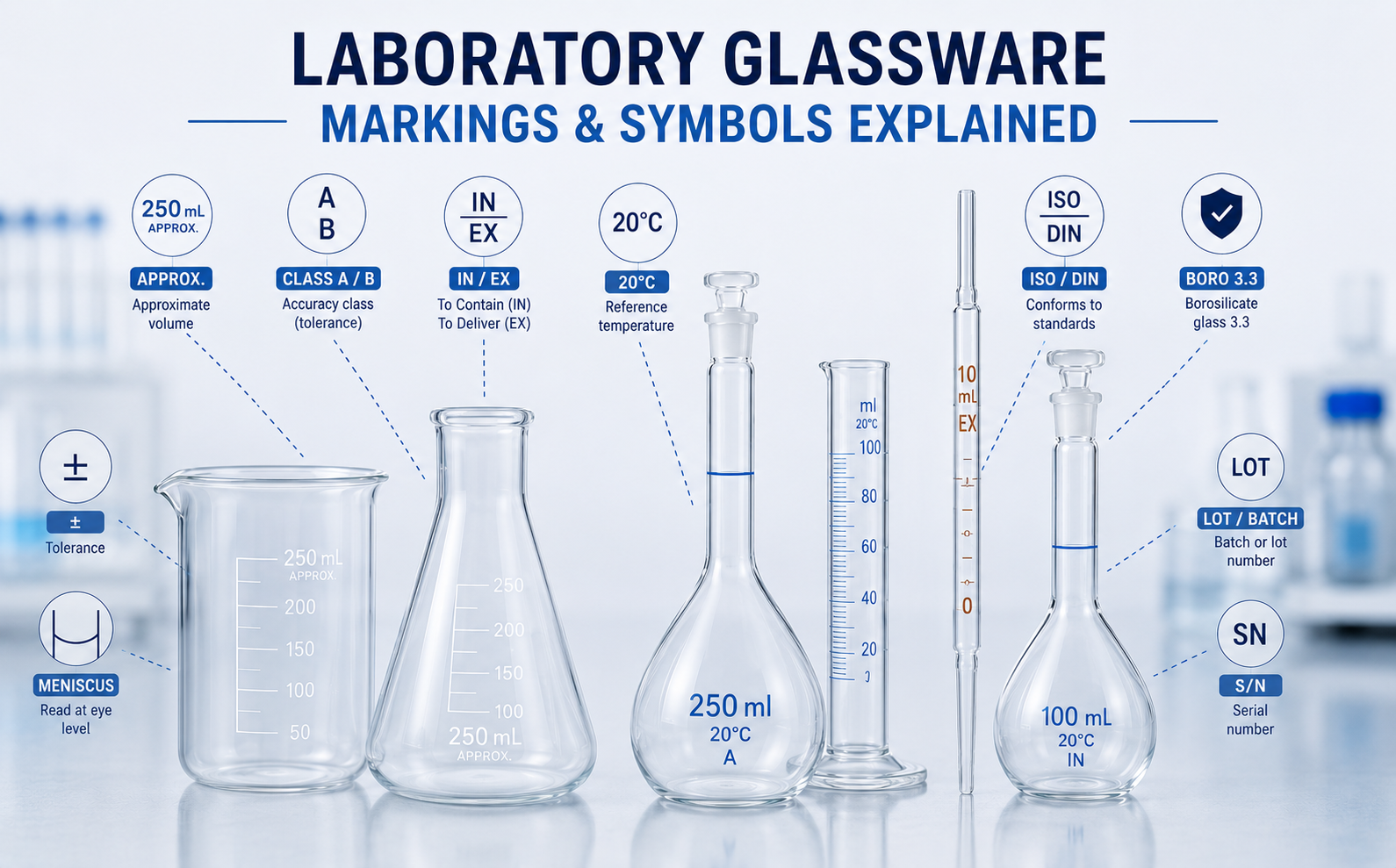
Common Laboratory Glassware Markings
mL – Nominal Volume
Indicates the nominal capacity of the glassware.
However, two products marked 250 mL do not necessarily have the same volumetric accuracy.
Approx. – Approximate Volume
Approx. means approximately.
It is commonly found on general-purpose glassware such as beakers and Erlenmeyer flasks.
These graduations are intended primarily for volume estimation rather than precision volumetric measurement.
Class A
Class A indicates tighter volumetric tolerances as defined by the applicable product standard.
It is commonly associated with precision volumetric glassware.
However:
Class A ≠ Individual Calibration Certificate
Class AS
Class AS is used for certain volumetric products where Class A tolerances are combined with additional characteristics defined by the applicable standard, such as specific flow or waiting-time requirements.
Class B
Class B generally allows wider volumetric tolerances than Class A.
Exact tolerances depend on product type, nominal capacity and the applicable standard.
IN / TC – To Contain
Indicates that the vessel is calibrated to contain the stated volume.
This is common for volumetric flasks.
EX / TD – To Deliver
Indicates that the glassware is calibrated to deliver the stated volume under specified conditions.
This is commonly associated with pipettes and burettes.
20 °C – Reference Temperature
Volumetric glassware is calibrated with reference to a defined temperature, commonly 20 °C.
For example:
250 mL A IN 20 °C
can be interpreted as:
250 mL nominal volume + Class A + calibrated to contain + 20 °C reference temperature.
± – Tolerance
The ± symbol may indicate a defined permissible deviation.
For example:
100 mL ± 0.10 mL
Tolerance should not be confused with measurement uncertainty.
ISO / DIN
These indicate references to international or German standards.
The actual standard number and scope should always be checked rather than relying on the letters alone.
Borosilicate 3.3
This identifies the glass material rather than its volumetric accuracy.
Borosilicate 3.3 is widely used in laboratories because of its low thermal expansion and good chemical and hydrolytic resistance.
LOT / Batch Number
Identifies a production group and supports traceability between:
Product → Production Batch → QC Records → Certificate
S/N – Serial Number
A serial number normally identifies an individual item.
Therefore:
LOT = Group identification
S/N = Individual identification
Quick Reference
| Marking | Meaning |
|---|---|
| Approx. | Approximate volume |
| Class A | Tighter volumetric tolerance |
| Class AS | Class A plus defined AS characteristics |
| Class B | Wider volumetric tolerance |
| IN / TC | To Contain |
| EX / TD | To Deliver |
| 20 °C | Reference temperature |
| ISO | International standard reference |
| DIN | German standard reference |
| Borosilicate 3.3 | Glass material |
| LOT | Production batch |
| S/N | Serial number |
Common Misunderstandings
Graduations mean precision. → Not necessarily.
Class A means a calibration certificate is included. → Not necessarily.
Approx. means poor quality. → Incorrect.
Borosilicate 3.3 is an accuracy class. → Incorrect.
Blue graduations automatically mean Class A. → Incorrect.
Conclusion
Glassware markings provide valuable information about volume, accuracy class, calibration method, reference temperature, material and traceability.
They should always be interpreted together and in relation to the applicable product standard.

