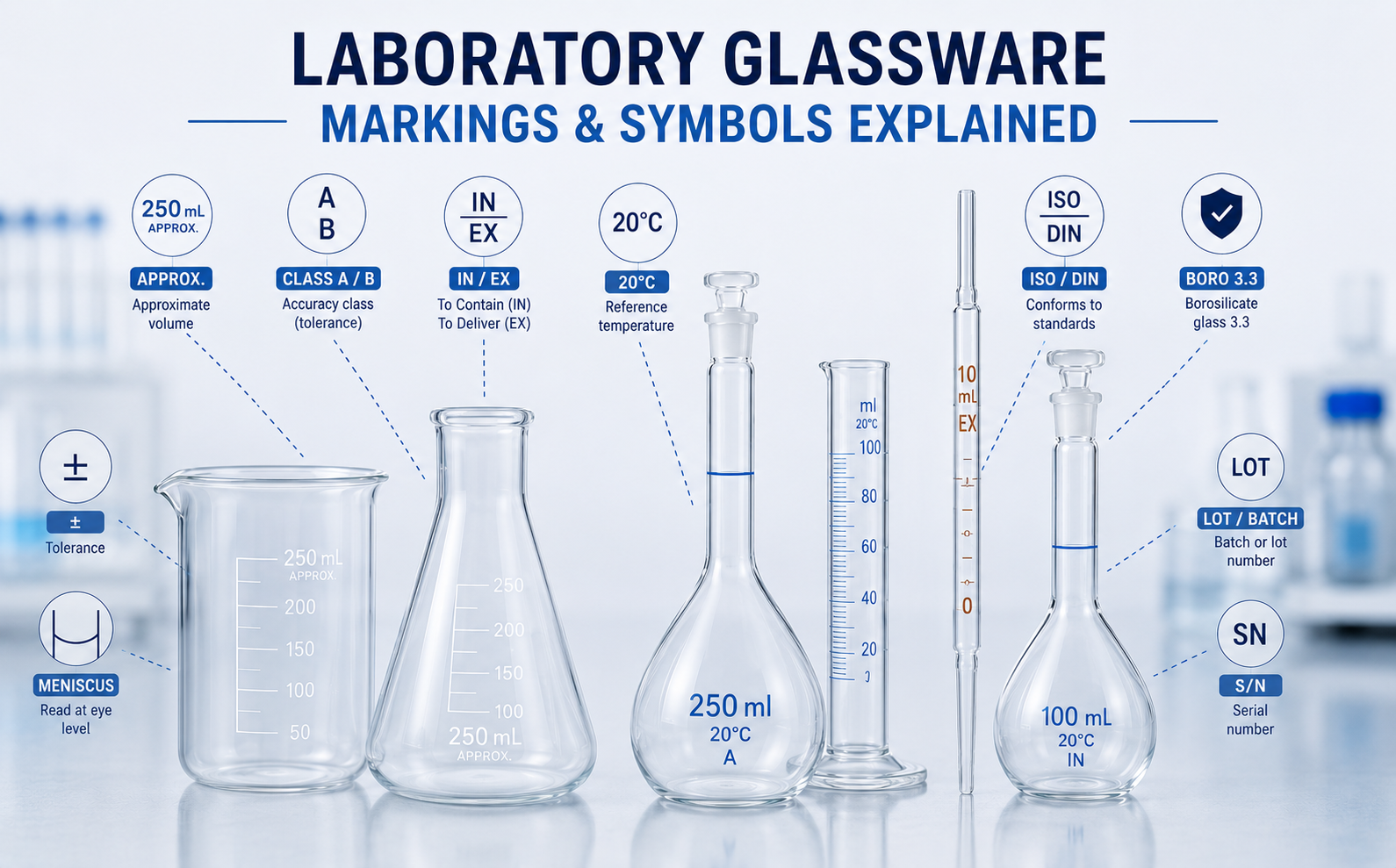
The abbreviation “Approx.” commonly found on laboratory glassware stands for “Approximately.” When a beaker or Erlenmeyer flask is marked: 250 mL Approx. the marking indicates an approximate volume rather than the performance expected from precision volumetric glassware.

Why Is “Approx.” Used?
Beakers and Erlenmeyer flasks are primarily designed for operations such as:
- mixing,
- heating,
- transferring liquids,
- performing reactions,
- estimating liquid volume.
Their graduation marks provide a convenient visual indication of volume but are generally not intended for high-accuracy volumetric measurement.
Approximate vs Volumetric Glassware
| Feature | Beaker | Volumetric Flask |
|---|---|---|
| Volume indication | Approximate | Volumetric |
| Precision solution preparation | Not intended | Intended |
| Mixing | Excellent | Not its primary purpose |
| Class A/B | Generally not applicable | May apply |
| Reference temperature | Usually not critical | Specified |
Therefore:
100 mL Beaker ≠ 100 mL Volumetric Flask
even though both display the same nominal volume.
Does “Approx.” Mean Low Quality?
No.
A high-quality borosilicate glass beaker can have excellent chemical and thermal properties while still carrying approximate graduations.
Material quality and volumetric accuracy are different characteristics.
Approx. vs Tolerance
These terms should not be confused.
Approx. indicates an approximate volume.
Tolerance defines an allowable deviation from a nominal value.
A volumetric product may, for example, have a specified tolerance such as:
100 mL ± 0.10 mL
This is fundamentally different from an approximate graduation.
Class A and Class B
Volumetric glassware may be classified as Class A or Class B according to the applicable product standard.
In general:
Class A → tighter tolerances
Class B → wider tolerances
Approximate beaker graduations should not be interpreted as equivalent to these volumetric classifications.
Common Volume Markings
| Marking | General Meaning |
|---|---|
| Approx. | Approximate volume |
| Class A | Tighter volumetric tolerance class |
| Class B | Wider volumetric tolerance class |
| IN / TC | Calibrated to contain |
| EX / TD | Calibrated to deliver |
| 20 °C | Reference/calibration temperature |
| ± mL | Defined volume tolerance |
When Is Approximate Glassware Suitable?
Approximate graduations are useful for:
Mixing, heating, reactions, liquid transfer and approximate volume estimation.
For standard solution preparation, precise dilution or analytical volumetric measurement, appropriate calibrated volumetric glassware should be selected.
Conclusion
Approx. = Approximately
It does not indicate poor quality. It tells the user that the volume indication should be treated as an approximate value rather than a precision volumetric measurement.