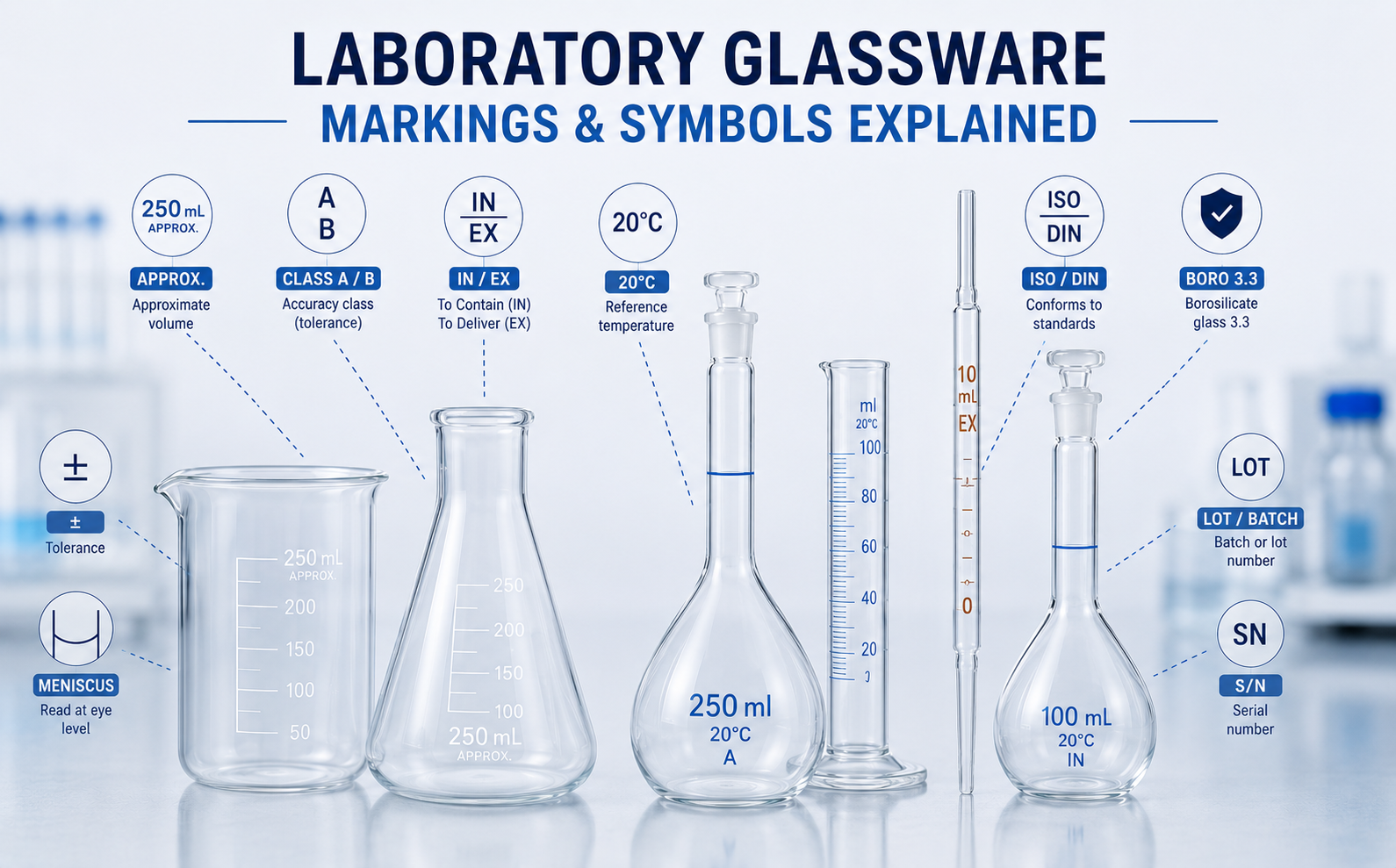
Acids and bases are among the most commonly used chemicals in laboratories. From solution preparation and titration to sample treatment and chemical reactions, they are involved in numerous procedures. Selecting the correct laboratory glassware is essential for both safe operation and reliable analytical results. The choice should consider chemical resistance, concentration, temperature, contact time and the intended laboratory procedure.

Why Is Borosilicate 3.3 Glass Commonly Used?
Borosilicate 3.3 glass is widely used for laboratory applications involving acids and bases because it provides:
- High chemical resistance
- High hydrolytic resistance
- Low thermal expansion
- Good resistance to temperature changes
- Compatibility with many laboratory reagents
Beakers, Erlenmeyer flasks, volumetric flasks, burettes, pipettes and laboratory bottles are therefore commonly manufactured from borosilicate glass.
However, high chemical resistance does not mean universal resistance to every acid or base.
Choosing Glassware for Acids
Borosilicate glass offers good resistance to many commonly used mineral and organic acids.
Nevertheless, compatibility should always be evaluated according to:
type of acid + concentration + temperature + contact time.
Concentrated chemicals, elevated temperatures and prolonged exposure may require additional compatibility verification.
What About Hydrofluoric Acid?
Hydrofluoric acid (HF) is a major exception.
HF can react with the silica present in glass and attack the glass surface. Standard borosilicate glassware is therefore unsuitable for the preparation, handling or storage of hydrofluoric acid.
An appropriately compatible polymer container should be selected instead.
Choosing Glassware for Bases
Strong alkaline solutions can gradually attack glass surfaces, particularly when combined with:
- high NaOH or KOH concentrations,
- elevated temperatures,
- prolonged contact.
A vessel suitable for short-term solution preparation may therefore not necessarily be appropriate for long-term storage.
Beaker or Erlenmeyer Flask?
Beakers are suitable for mixing, heating, transferring and preparing solutions. Their graduations are generally intended for approximate volume indication rather than precise measurement.
Erlenmeyer flasks are particularly useful for mixing and titration. Their conical shape allows swirling with a reduced risk of splashing.
This makes them especially useful in acid-base titrations.
When Should a Volumetric Flask Be Used?
When preparing a solution to an accurately defined final volume, a volumetric flask should be used.
It provides substantially greater volumetric accuracy than a standard beaker or Erlenmeyer flask.
Hot solutions should not normally be made up directly to the calibration mark. Volumetric glassware should be used with consideration of its calibration temperature.
Selecting a Burette for Titration
Burettes allow titrants to be delivered accurately and controllably.
For acid-base titrations, consider:
- capacity,
- graduation interval,
- accuracy class,
- scale readability,
- chemical compatibility of the stopcock.
For high-accuracy applications, Class A or Class AS burettes may be appropriate.
Pipette Selection
When an accurately measured volume of an acid or base solution must be transferred, the correct pipette should be selected.
Volumetric pipettes are designed for highly accurate transfer of one specified volume, while graduated pipettes provide flexibility for measuring different volumes.
Storing Acids and Bases in Glass Bottles
Long-term storage requires additional consideration.
Evaluate:
- chemical type,
- concentration,
- light sensitivity,
- storage temperature,
- closure and seal material.
Even when the glass body is chemically compatible, the cap or seal may not provide the same resistance.
Clear or Amber Glass?
For light-sensitive solutions, amber glass bottles can help reduce exposure to certain wavelengths of light.
For solutions that are not light-sensitive, clear glass provides convenient visual inspection of the contents and liquid level.
What If Heating Is Required?
If an acid or base solution will be heated, thermal resistance must be considered in addition to chemical resistance.
The low thermal expansion of borosilicate 3.3 glass is advantageous in many heating applications.
Nevertheless, sudden cooling of hot glass can cause thermal shock and breakage.
Never Ignore Damaged Glassware
Before working with corrosive chemicals, inspect glassware for:
- cracks,
- microcracks,
- deep scratches,
- chipped rims,
- damaged stopcocks or joints.
Chemical and thermal stress may cause existing defects to propagate and lead to unexpected failure.
Quick Selection Checklist
Before using glassware with an acid or base, ask:
- What is the chemical and its concentration?
- Is the glass chemically compatible?
- What is the operating temperature?
- How long will contact last?
- Will heating or cooling be involved?
- Is precise volume measurement required?
- Are the cap, seal and stopcock compatible?
- Is the glassware free from damage?
Conclusion
Choosing the right laboratory glassware for acids and bases is essential for safety, chemical compatibility and analytical reliability.
Borosilicate 3.3 glass is suitable for a wide range of applications because of its excellent chemical and thermal properties. However, compatibility must always be evaluated according to the specific operating conditions.
Particular attention should be given to hydrofluoric acid, strong alkalis, elevated temperatures and prolonged storage.