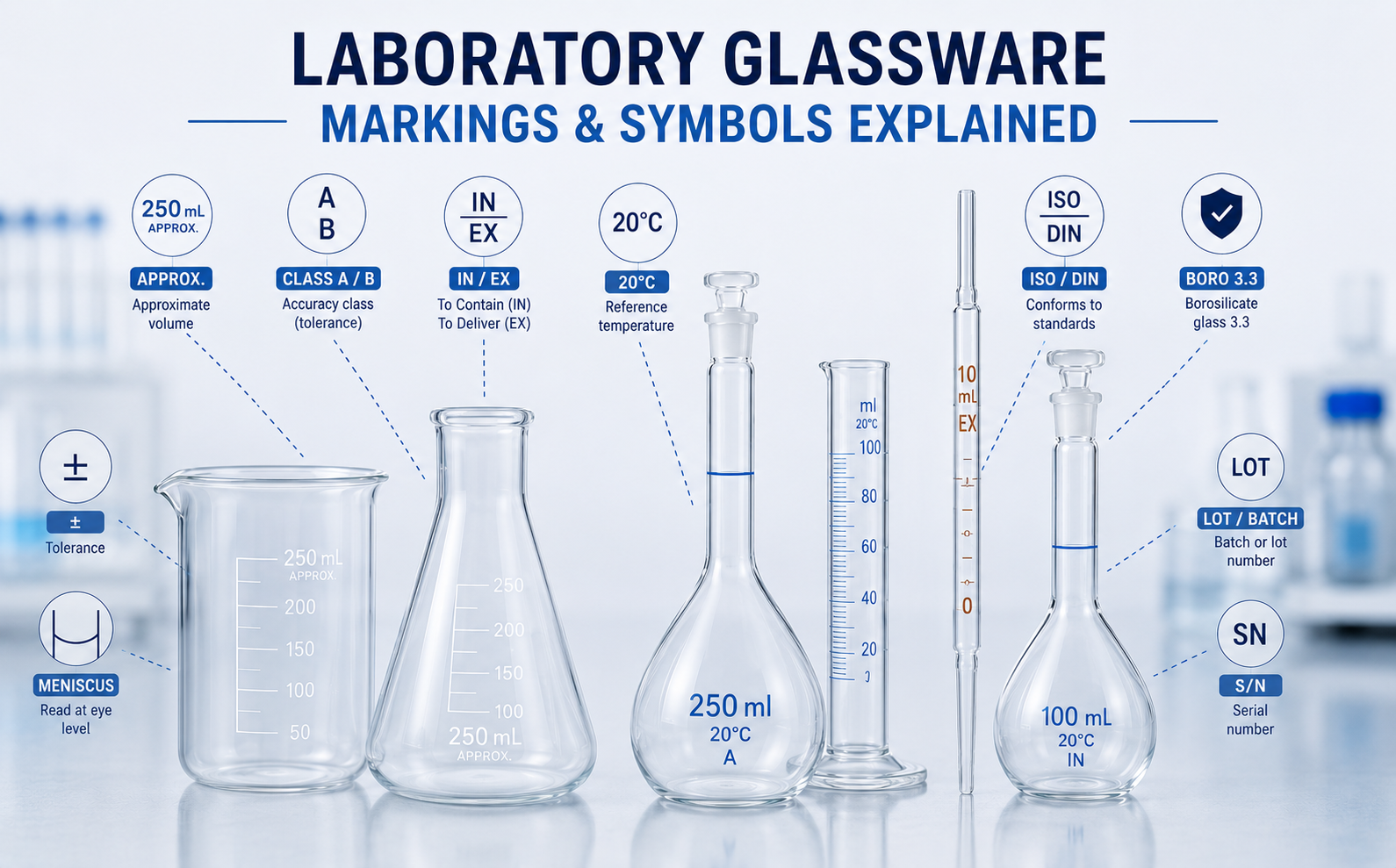
Quality in laboratory glassware cannot be judged by appearance alone. True quality is determined by a combination of glass composition, manufacturing precision, measurement accuracy, thermal and chemical resistance, surface quality and compliance with relevant standards. Knowing what to look for when selecting beakers, Erlenmeyer flasks, volumetric flasks, burettes, pipettes or laboratory bottles helps improve both safety and reliability.

1. Check the Type of Glass
High-quality laboratory glassware should clearly state the glass material used.
For many general laboratory applications, borosilicate 3.3 glass is widely preferred because of its low thermal expansion and high chemical resistance.
It offers:
- good resistance to temperature changes,
- resistance to many chemicals,
- suitability for numerous heating and reaction applications.
However, the technical specifications and manufacturing standards should also be checked.
2. Inspect the Glass Surface
A quality glass product should have a uniform and well-finished surface.
Look for:
- no visible cracks,
- no chipped or sharp edges,
- minimal visible bubbles or deformation,
- reasonably uniform wall thickness,
- properly formed rims and bases.
Uneven glass thickness may negatively affect thermal stress distribution.
3. Examine Graduation and Printing Quality
For graduated products such as cylinders, burettes, pipettes and beakers, markings should be clear and easy to read.
Good-quality products should have:
- sharp graduation lines,
- legible numbers,
- consistent alignment,
- durable printing.
For volumetric products, however, actual calibration accuracy is more important than appearance alone.
4. Check Volume Tolerance
For volumetric glassware such as volumetric flasks, pipettes and burettes, tolerance is one of the most important quality parameters.
Two products with the same nominal capacity may have different allowable errors.
For accurate work, check the specified tolerance according to Class A, Class AS or the applicable standard.
A narrower tolerance generally means greater volumetric accuracy.
5. Look for ISO and DIN Compliance
Quality laboratory glassware may be manufactured according to relevant ISO or DIN standards.
Depending on the product, these standards may define:
- dimensions,
- volume tolerances,
- design,
- calibration principles,
- performance requirements.
Standard information on the product or technical documentation is therefore an important quality indicator.
6. Check Stability and Base Design
Products such as beakers, flasks, bottles and graduated cylinders should stand securely on the laboratory bench.
A good base should be stable, level and resistant to rocking.
This is particularly important for tall graduated cylinders and narrow vessels.
7. Inspect Rim and Pouring Design
In beakers, the pouring spout should allow liquids to be transferred smoothly and controllably.
Poorly formed spouts may cause dripping, uncontrolled flow or liquid running down the outside of the vessel.
Rim and neck geometry are also important for compatibility with stoppers, caps and fittings.
8. Examine Ground Joints
For glassware with ground joints, joint quality is critical.
A good ground joint should:
- have a uniform finish,
- fit the matching component correctly,
- not be excessively tight or loose,
- comply with the specified standard size.
Poorly matched joints may increase the risk of leakage, sticking or breakage.
9. Evaluate Thermal Performance
Glassware used for heating must withstand the intended temperature conditions.
Borosilicate 3.3 performs well because of its low thermal expansion, but thermal performance also depends on manufacturing consistency and wall thickness distribution.
10. Consider Chemical Resistance
Laboratory glassware may come into contact with acids, bases, solvents and reagents.
A high-quality glass surface should remain chemically stable under appropriate operating conditions.
However, no glass is universally resistant to every chemical. Special care is required with strong alkalis, hydrofluoric acid and other aggressive substances.
11. Check Calibration Information on Volumetric Glassware
For volumetric flasks, pipettes and burettes, useful quality information includes:
Nominal capacity + tolerance + calibration temperature + In/Ex marking + accuracy class
For example:
100 mL – Class A – In – 20 °C
This information helps users understand how the product has been calibrated.
12. Look for Product Identification and Traceability
Professional laboratory glassware may include product codes, nominal capacity, glass type and, where applicable, lot or traceability information.
These details are useful for quality control, purchasing and laboratory standardization.
Conclusion
Quality in laboratory glassware is not just about visual appearance.
It is the combination of:
Correct glass type + precise manufacturing + suitable tolerance + clear graduations + standards compliance + thermal and chemical resistance + reliable technical information
High-quality laboratory glassware supports safer operation, better measurement accuracy, longer service life and more reliable experimental results.