Laboratory bottles are widely used to store chemicals, reagents, solutions and samples. Two of the most common options are clear glass bottles and amber glass bottles. The difference is not merely aesthetic. Glass colour affects light transmission, which can influence the stability of photosensitive substances.

Clear Laboratory Bottles
Clear bottles provide excellent visibility of their contents.
They make it easy to inspect:
- liquid level,
- colour changes,
- precipitation,
- turbidity,
- foreign particles.
For chemicals that are not sensitive to light, clear glass is often a practical choice.
Amber Laboratory Bottles
Amber bottles are designed to reduce the transmission of certain wavelengths of light, particularly ultraviolet and shorter-wavelength visible light.
They are therefore commonly used for photosensitive chemicals and solutions.
Why Can Light Damage Chemicals?
When certain molecules absorb light of sufficient energy, photochemical reactions can occur.
Possible effects include:
- decomposition,
- oxidation,
- colour changes,
- concentration changes,
- loss of active material.
This process is generally referred to as photodegradation.
Clear vs. Amber Glass
| Feature | Clear Glass | Amber Glass |
|---|---|---|
| Content visibility | Excellent | Reduced |
| Light protection | Low | Higher |
| Visual inspection | Excellent | More limited |
| Photosensitive substances | Generally not preferred | Generally preferred |
| General reagent storage | Excellent | Suitable |
| Main advantage | Visibility | Light protection |
Which Chemicals May Require Amber Bottles?
Amber bottles may be appropriate for certain:
- silver salts,
- iodine-containing solutions,
- vitamins,
- dyes and indicators,
- pharmaceutical substances,
- photosensitive organic compounds,
- analytical standards.
The specific chemical's SDS, manufacturer instructions or applicable analytical/pharmacopoeial method should always take priority.
Why Is Silver Nitrate Stored Away from Light?
Silver nitrate is a classic example of a light-sensitive chemical. Exposure to light can promote undesirable photochemical changes.
Amber glass can therefore help reduce light exposure during storage.
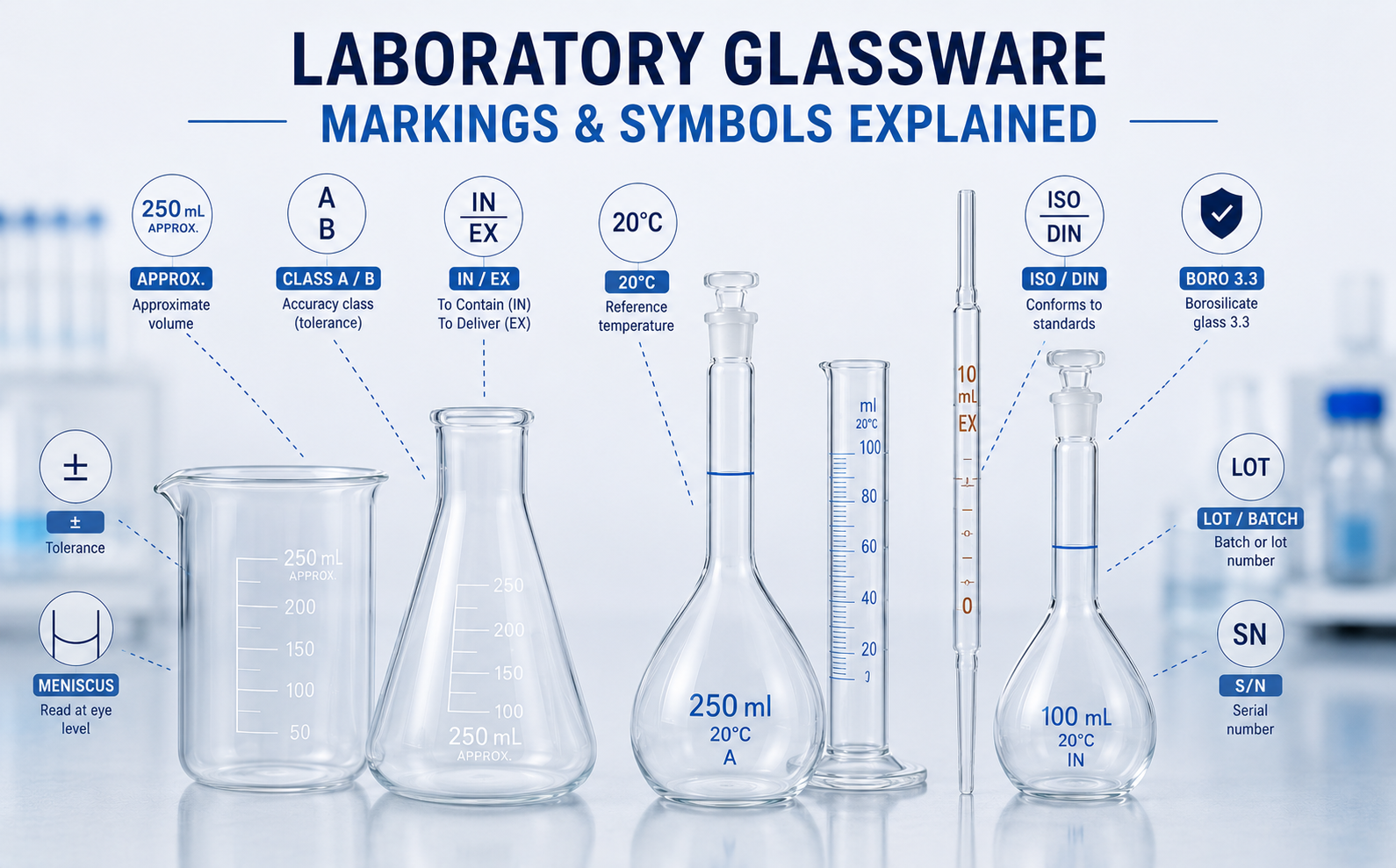
Borosilicate 3.3 Glass
Borosilicate 3.3 is widely used for laboratory reagent bottles because of its:
- low thermal expansion,
- high hydrolytic resistance,
- good resistance to many chemicals,
- good thermal properties.
However, chemical resistance and light protection are separate properties. A clear borosilicate bottle does not automatically protect its contents from light.
Is Glass Colour the Only Selection Criterion?
No. Also consider:
- chemical compatibility,
- stopper or cap material,
- sealing performance,
- storage temperature,
- bottle capacity,
- need for visual inspection.
The cap, liner and sealing system can be just as important as the glass body.
Can Aluminium Foil Replace an Amber Bottle?
Wrapping a clear bottle in aluminium foil can physically block light and is sometimes used as a temporary laboratory measure.
For routine storage, however, an appropriate amber bottle is generally more convenient. If a standardized method specifies a particular container, that requirement should be followed.
Does an Amber Bottle Still Need Dark Storage?
Potentially, yes.
Amber glass reduces light exposure but does not make the container completely light-proof.
If storage instructions state “Protect from light,” additional protection from sunlight or strong artificial illumination may still be required.
Quick Selection Guide
Photosensitive substance → Amber bottle
Light-stable substance requiring easy visual inspection → Clear bottle
The final choice should consider:
glass type + photosensitivity + chemical compatibility + closure system + temperature + storage conditions.