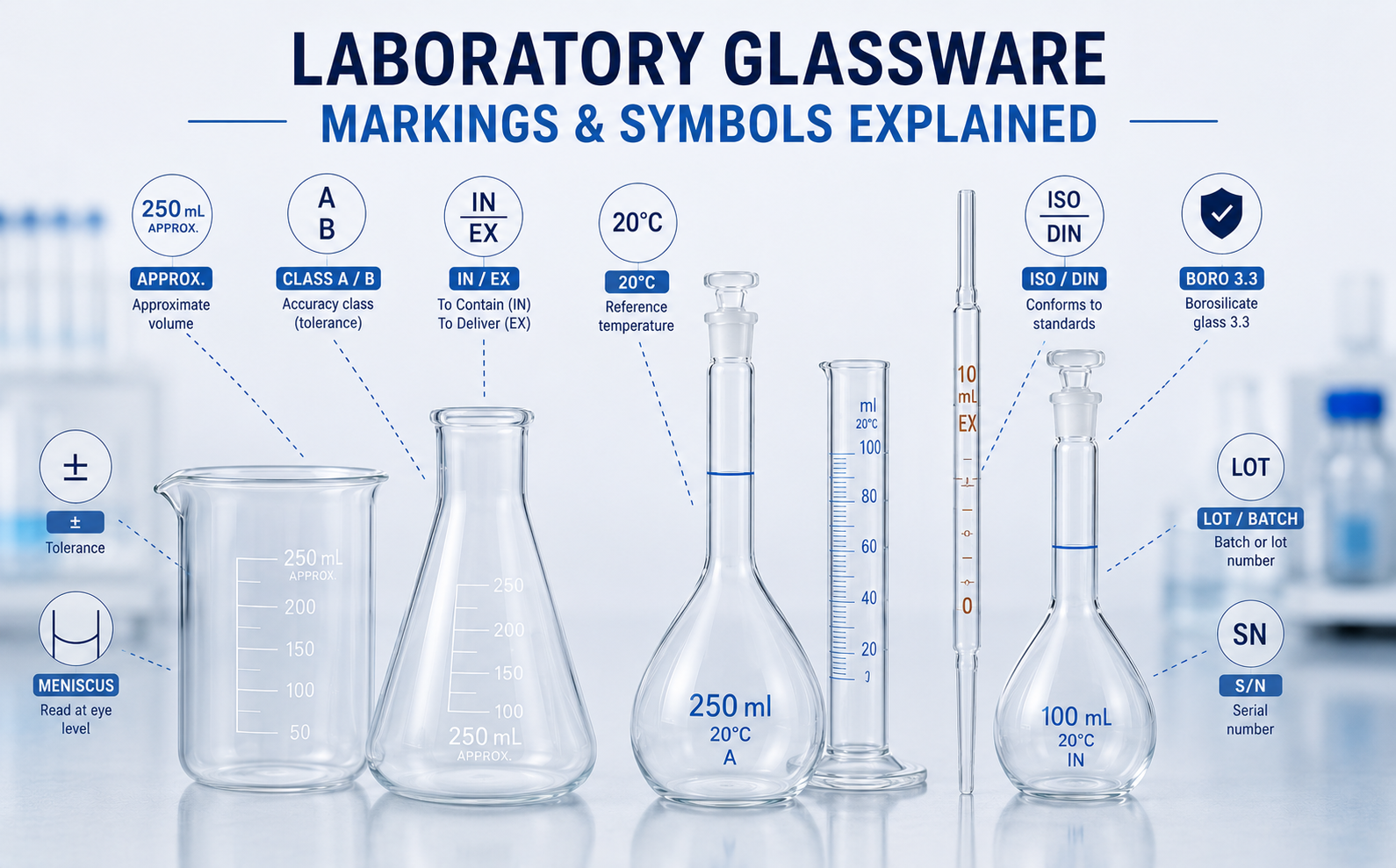
Low thermal expansion, high chemical durability and why it is the standard material for laboratory glass.

Low thermal expansion, high chemical resistance, and why it has become a standard material for laboratory glassware.
The type of glass used in laboratory equipment directly affects its performance under temperature changes, chemical exposure, and routine laboratory conditions. This is why borosilicate 3.3 glass is widely used for professional laboratory glassware, from beakers and Erlenmeyer flasks to round-bottom flasks and laboratory apparatus.
But what makes Borosilicate 3.3 different from conventional glass?
What is Borosilicate 3.3?
Borosilicate glass is a special type of glass primarily containing silica and boron oxide. The designation “3.3” refers to its low thermal expansion characteristics. Borosilicate 3.3 has a linear coefficient of thermal expansion of approximately 3.3 × 10⁻⁶ K⁻¹.
This means that the glass undergoes relatively little dimensional change when its temperature changes—an important advantage in laboratory applications.
Why does low thermal expansion matter?
Laboratory glassware may be exposed to heating, cooling, and liquids at different temperatures.
A low coefficient of thermal expansion helps reduce internal stresses caused by temperature changes. As a result, under appropriate conditions of use, Borosilicate 3.3 offers better resistance to thermal shock than conventional soda-lime glass.
However, no laboratory glassware is completely immune to sudden or uncontrolled temperature changes. Proper heating and cooling procedures should always be followed.
High chemical resistance
Another major reason for the widespread use of Borosilicate 3.3 in laboratories is its high chemical resistance.
Its glass structure provides excellent resistance to water and many chemical substances, making it suitable for routine analysis, sample preparation, mixing, and numerous other laboratory applications.
Chemical resistance always depends on factors such as the chemical involved, concentration, temperature, and exposure time.
Why is it so widely used in laboratory glassware?
Borosilicate 3.3 is widely used not because of a single property, but because it provides a balanced combination of important characteristics:
- Low thermal expansion
- High resistance to thermal shock
- High hydrolytic and chemical resistance
- Good optical transparency
- Suitability for a wide range of laboratory applications
- Durability for repeated laboratory use
Together, these properties make Borosilicate 3.3 an ideal material for many types of glassware used in scientific, industrial, educational, and research laboratories.
BOROX and Borosilicate 3.3
Depending on the intended application and technical requirements, BOROX laboratory glassware is available in Borosilicate 3.3 options.
From beakers and Erlenmeyer flasks to flasks and laboratory systems, choosing the right glass is an important factor in reliable laboratory work, product service life, and workflow efficiency.
BOROX® — Precision in Every Detail.