An automatic burette is a laboratory volumetric instrument designed to simplify the filling and controlled delivery of titrant during titration. In reservoir-fed glass systems, the burette is connected directly to a reagent bottle. A manual pressure mechanism, pump or similar filling system transfers the titrant from the reservoir into the graduated burette tube.

How Does It Work?
A typical workflow is:
Reservoir → Burette filling → Initial level setting → Titration → Volume reading
Compared with a conventional burette, the main advantage is that the operator does not have to manually transfer titrant into the burette before every analysis.
Automatic vs. Conventional Burette
| Feature | Conventional Burette | Automatic Burette |
|---|---|---|
| Filling | Manual | Automatic/semi-automatic from reservoir |
| Reservoir | Separate | Usually integrated |
| Repetitive titrations | More manual work | More convenient |
| Volume reading | Manual | Manual on glass models |
| Endpoint detection | Manual/method-dependent | Usually manual/method-dependent |
An automatic-filling burette should not be confused with a fully automatic titrator.
Main Advantages
Automatic burettes can provide:
- faster refilling,
- easier repetitive titration,
- reduced manual transfer of titrant,
- convenient use of the same titrant for multiple samples,
- more standardized laboratory workflow.
What Is a Schellbach Stripe?
Some burettes incorporate a Schellbach stripe, designed to make the liquid meniscus easier to observe.
It can improve reading convenience, particularly with clear solutions.
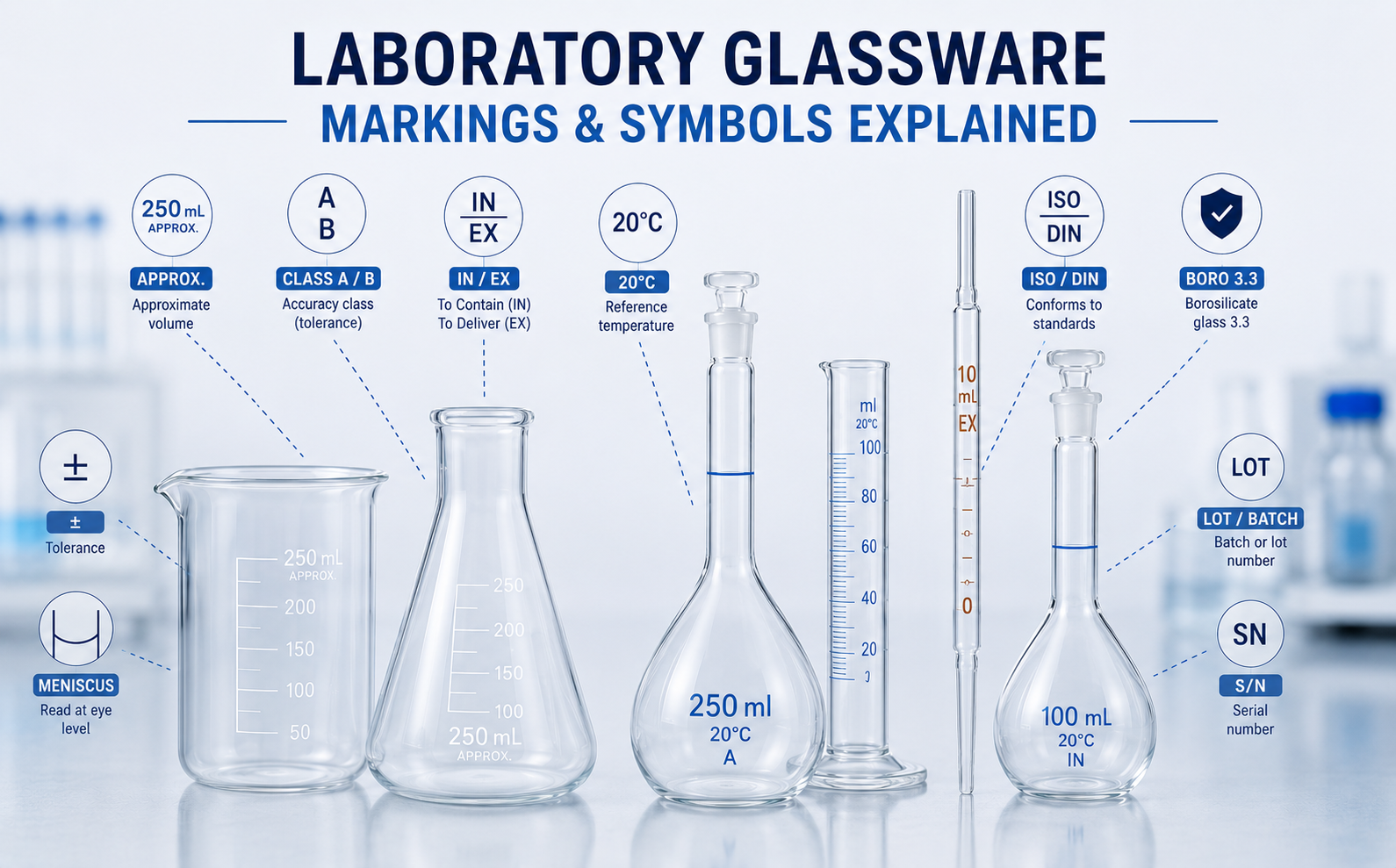
Class A and Class AS
Accuracy class is an important consideration when selecting volumetric glassware.
Class A products are manufactured to high volumetric accuracy requirements.
Class AS products also meet high accuracy requirements while complying with additional performance requirements defined by the relevant standard, such as delivery characteristics.
For laboratory burettes, compliance with applicable standards such as ISO 385 may be relevant.
Where Are Automatic Burettes Useful?
They can be particularly beneficial in:
- quality-control laboratories,
- analytical chemistry laboratories,
- pharmaceutical laboratories,
- food laboratories,
- water and environmental laboratories,
- petrochemical and industrial laboratories.
They are especially practical when many samples are titrated routinely using the same titrant.
Common Applications
Automatic burettes may be used for:
- acid-base titration,
- redox titration,
- complexometric titration,
- precipitation titration,
- acidity and alkalinity determination,
- hardness and chloride analyses,
- various assay procedures.
Choosing the Correct Capacity
Common capacities may include:
10 mL, 25 mL, 50 mL and 100 mL.
The appropriate capacity should be selected according to the expected titrant consumption and the requirements of the analytical method.
What Should You Check Before Buying?
Consider:
- nominal capacity,
- accuracy class,
- applicable standard,
- graduation readability,
- Schellbach stripe if required,
- stopcock design,
- reservoir capacity,
- chemical compatibility,
- availability of replacement components,
- calibration or batch documentation where required.
Correct Use
Before titration, ensure that:
- the burette is clean,
- there are no air bubbles in the tip,
- the stopcock does not leak,
- all connections are secure,
- the titrant has been correctly prepared and standardized,
- the meniscus is read at eye level.
Automatic Burette vs. Automatic Titrator
These are different instruments.
An automatic-filling glass burette mainly simplifies filling and manual titrant delivery.
An automatic titrator may automate titrant dosing, endpoint detection, measurement, calculation and data recording.
Conclusion
Automatic burettes are particularly useful for laboratories performing frequent repetitive titrations with the same titrant.
The correct choice should consider:
capacity + accuracy class + standards + glass quality + graduation + stopcock + reservoir + chemical compatibility.